
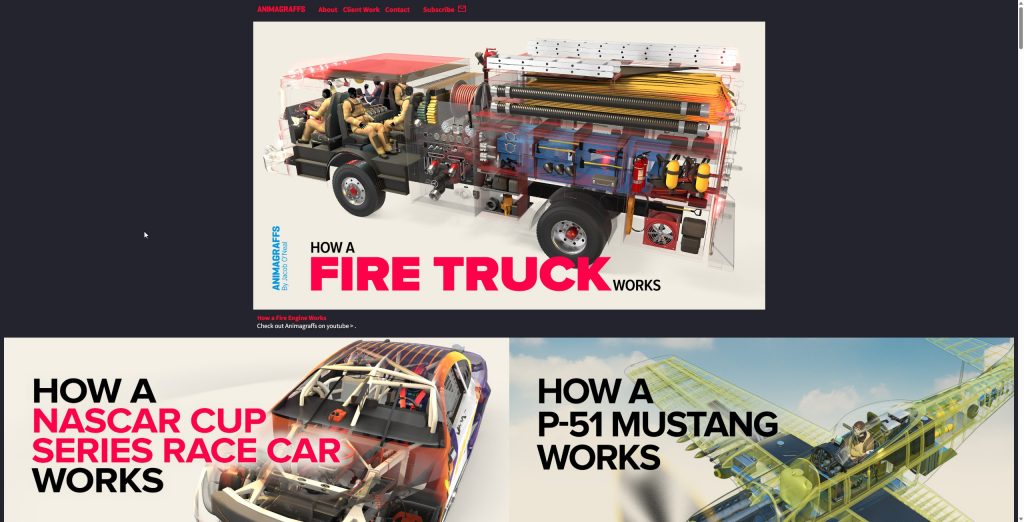

Some websites exist to be useful. A rare few exist to be genuinely good. animagraffs.com is one of the latter — a portfolio and publication from designer and 3D artist Jacob O’Neal that has quietly become one of the most cited, most shared, and most legitimately impressive educational sites on the internet.
If you’ve ever searched “how a car engine works” and landed on a beautifully rendered animated breakdown that actually explained things, you’ve already been here. This is that site. And it’s worth looking at properly.
The Problem With Explaining Complex Things Online
There’s no shortage of content about how mechanical and scientific systems work. There is, however, a severe shortage of content that explains them in a way that actually lands. Most written explainers assume too much or too little. Most YouTube videos are either too long or poorly paced. Textbook diagrams exist behind institutional paywalls, and the free versions are often ugly and incomplete.
The gap between “I want to understand how a jet engine actually works” and “I now actually understand it” is frustratingly wide for most people. animagraffs.com closes that gap — not by simplifying, but by animating. There’s a meaningful difference.
What animagraffs.com Is, Exactly
animagraffs.com is a collection of animated infographics built by Jacob O’Neal — a largely self-taught graphic designer and 3D artist who builds detailed technical models in Blender, textures and renders them, then combines the output with motion graphics in Adobe After Effects to produce scrollable, animated explanations of how complex systems operate.
The result is not a YouTube channel, not a Wikipedia article, and not a slideshow. It’s something in between — a richly visual, browser-based experience where the animation is the explanation. O’Neal has described his process as beginning with deep research into patents, engineering forums, and technical manuals before a single model is built. That commitment to accuracy is visible in every piece.
Topics covered include car engines, jet engines, mechanical watches, electric guitars, speakers, hard disk drives, self-driving car systems, airbags, electric cars, the human eye, sewing machines, slot machines, modular synthesizers, and more. Each entry is its own standalone piece — not a chapter in a series, but a complete, self-contained visual essay.
The Quality of the Work Is the Point
Most review sites would put this under “Key Features,” but animagraffs.com isn’t a product with features. It’s a body of creative and technical work. The quality of that work is the reason to visit, the reason to share it, and the reason it has remained relevant for years after each piece was published.
The “How a Car Engine Works” infographic — O’Neal’s first major piece — went viral on its original upload, generating 30,000 visitors in a single day and crashing his initial hosting. Years later, it still ranks first for its target search phrase. That’s not luck. That’s the result of producing something that genuinely answers the question better than any alternative.
What makes the animations work is the use of labeled, color-coded motion to show exactly which part is doing what at each stage of a cycle or process. Watching a four-stroke engine cycle in slow motion — with each component highlighted as it activates — communicates something that no static diagram or text paragraph can replicate. You don’t read animagraffs. You watch them and understand.
Who Should Spend Time Here
The site’s audience is broader than you might expect from such technically detailed content. It’s not just engineers and hobbyists — it’s anyone who has ever been curious about how something actually works and wanted an answer that felt satisfying rather than simplified.
- Students studying mechanical engineering, physics, or biology who want visual reinforcement alongside textbook content
- Educators and teachers looking for classroom-appropriate visual aids that aren’t behind a paywall
- Curious adults who want real understanding without needing a degree to access it
- Designers and motion graphics artists looking at animagraffs as a benchmark for technically accurate 3D animation
- Content creators, journalists, and science communicators who cite or reference it in their own work
- Brands and agencies considering commissioning similar work — O’Neal is available for hire through the site
- Anyone who has ever watched a YouTube explainer and felt like they still didn’t really understand the thing
What Works — and What Doesn’t
✅ The Case For It
- The animation quality is genuinely excellent — 3D modeling, motion, and technical accuracy combine in a way that’s rare for free online content
- Every piece is fully researched — O’Neal uses patents, engineering forums, and technical manuals as primary sources, not Wikipedia
- Content is free to access and requires no account or subscription
- The site has remarkable SEO authority — its entries tend to rank at or near the top of searches for their topics because they are, objectively, the best available answer
- Work spans a genuinely diverse range of subjects: mechanical, biological, technological, and cultural topics
- The viral track record (multiple pieces hit hundreds of thousands of views) reflects genuine quality, not manufactured attention
❌ Where It Falls Short
- The library is small — there are no more than a few dozen complete pieces, meaning most topics are not covered
- New entries are infrequent — O’Neal produces commercial work and the site is not updated on any predictable schedule
- No search or filtering — you browse what’s there, and if your topic isn’t listed, you leave empty
- Mobile experience varies — some of the scroll-driven animations are better experienced on desktop
- No audio narration — the animations are visual-only, which suits some learners better than others
- The site is essentially a portfolio, which means it prioritizes depth over breadth
How It Sits Alongside Other Visual Learning Resources
vs. Kurzgesagt (YouTube)
Kurzgesagt produces animated explainer videos with enormous budgets, large teams, and a dedicated publishing schedule. It covers a wider range of topics and reaches a vastly larger audience. But its animations are illustrative rather than technically precise — they prioritize accessibility and visual charm over engineering accuracy. animagraffs works from primary technical sources and builds 3D models based on actual component geometry. The result is a different kind of understanding: Kurzgesagt gives you the concept, animagraffs gives you the mechanism. Bottom line: Both are valuable, neither replaces the other — use Kurzgesagt for big-picture science, animagraffs when you want to know exactly how the parts move.
vs. Khan Academy
Khan Academy is a structured curriculum platform with thousands of lessons, assessments, and a progression system. It serves learners who need to work through a subject systematically. animagraffs is the opposite: no curriculum, no progression, no assessment — just standalone pieces on individual topics. If you’re studying for an exam, Khan Academy is the tool. If you’re trying to build genuine intuitive understanding of a specific system, animagraffs often does it faster and more memorably. Bottom line: These serve different learning modes — Khan Academy for breadth and structure, animagraffs for depth and intuition on specific mechanical or technical topics.
Access and Cost
- All published infographics: Free, no account required
- Subscription or premium tier: None
- Commercial use of content: Contact the creator directly — content is original IP
- Commissioning custom work: O’Neal accepts client projects; contact available through the site
Start with the car engine piece if you haven’t before. Then the jet engine. Then whichever topic you’ve always been vaguely curious about: visit animagraffs.com and pick one.
Make the Visit — Or Don’t
animagraffs.com is worth your time if:
- You’ve ever left a search result feeling like the explanation didn’t actually explain anything
- You’re a student who needs more than a static diagram to understand a mechanical process
- You teach, communicate, or create content about science or engineering
- You’re a designer or motion graphics professional looking for a technical accuracy benchmark
- You appreciate craft and want to see what’s possible when one person applies serious skill to a serious subject
- You want free, high-quality visual content without a subscription or account
- A topic in the existing library matches something you’ve been trying to understand
Move on if:
- The specific topic you need isn’t in the library — the catalog is small
- You need structured learning with quizzes, progression, and outcomes
- You prefer audio-based or narrated explanations over visual-only content
- You need content updated on a regular publishing schedule
- You’re looking for beginner-level simplification — this aims for accuracy, which requires some baseline engagement
Final Verdict
animagraffs.com is not a platform, not a startup, not a content machine. It’s the work of one extremely skilled person applying serious craft to the problem of visual explanation. That’s precisely why it works as well as it does. There’s no editorial pressure to publish frequently, no growth team optimizing for clicks, no infographic-by-committee. Just technically grounded, visually precise, genuinely beautiful work on whatever O’Neal decides to build next.
The catalog is small. That’s the only real limitation, and it’s an honest one. For the topics that are covered, animagraffs produces the best freely accessible visual explanation available. That’s a high bar to clear and it clears it repeatedly.
If you’ve landed here having never visited the site, open it in another tab now. Search for whatever mechanical thing you’ve always half-wondered about. There’s a reasonable chance the answer is there, and a certainty that if it is, it’s better than anything else you’ll find.
Rating: 5 / 5 stars — A rare internet resource that delivers on its premise completely. Small catalog, enormous quality. Required bookmarking for anyone who cares about understanding how things actually work. Explore the full collection at animagraffs.com →
Disclosure: This post contains affiliate links. If you click through and take action, we may receive a commission at no extra cost to you. Our editorial opinions are independent and not influenced by affiliate relationships.