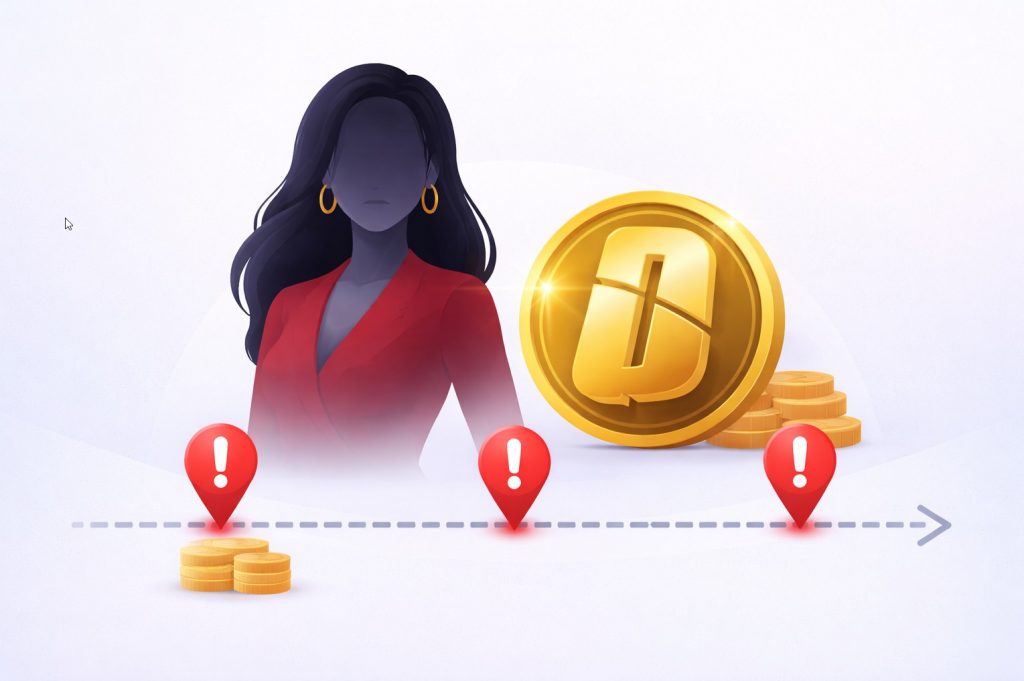

Dr. Ruja Ignatova stood on the stage of Wembley Arena in June 2016 and told 90,000 people across live venues worldwide that she was building the currency that would replace Bitcoin. Lights blazed. Music thumped. Thousands cheered. Ignatova wore a red ballgown and projected absolute confidence. Within a year, she would vanish entirely — leaving behind what prosecutors and regulators now describe as the largest cryptocurrency fraud in recorded history. OneCoin extracted an estimated $4 billion from investors across 175 countries before the structure collapsed. Understanding how it happened — and why it took so long to stop — matters for every investor operating in the crypto space today.
This is the full timeline of the OneCoin fraud: from Ignatova’s early career through the scheme’s construction, its global collapse, and the criminal proceedings that continue to unfold more than a decade after launch.
Who Was Ruja Ignatova?
Ruja Ignatova held a doctorate in private international and European law from the University of Konstanz. She spoke multiple languages fluently and carried herself with the polish of a McKinsey consultant — she had briefly been one. Born in Bulgaria in 1980, she spent much of her early career in corporate advisory and financial services. On paper, few credentials in the space looked stronger.
Her first significant fraud conviction arrived before OneCoin. A German court convicted Ignatova in 2012 for her role in a fraudulent insolvency scheme involving a manufacturing company. That conviction did not prevent her from building one of the world’s largest multi-level marketing networks within three years. Prosecutors later noted it as evidence of a pattern rather than a single lapse of judgment.[1]
Ignatova co-founded OneCoin Ltd in 2014 alongside Sebastian Greenwood, a Swedish MLM promoter with his own prior fraud history. Greenwood brought the distribution architecture. Ignatova provided the credibility wrapper — the academic titles, the financial vocabulary, and the stage presence that convinced buyers they were dealing with a serious fintech enterprise rather than a pyramid scheme.
The OneCoin Fraud Timeline: Year by Year
2014 — The Foundation Is Built
OneCoin Ltd formally registered in Sofia, Bulgaria and Dubai in late 2014. Ignatova designed the product around a core deception: OneCoin claimed to operate a blockchain. Promotional materials described sophisticated mining operations, a dedicated ledger, and a coin supply governed by genuine cryptographic processes. None of that infrastructure existed.[2]
What OneCoin actually sold was educational packages — tiered bundles priced from €100 to €118,000 that included “tokens” investors could convert into OneCoins. Higher-priced packages produced more tokens. Promoters earned commissions for recruiting new buyers. Every structural element replicated a classic pyramid scheme with cryptocurrency vocabulary layered on top.
Critically, OneCoin created no public blockchain. Independent researchers and journalists who attempted to verify the claimed blockchain found nothing. Ignatova’s response when pressed was to describe the blockchain as “private” — a characterisation that made verification conveniently impossible for ordinary investors.[3]
2015 — Rapid Global Expansion
By mid-2015, OneCoin had established promotional networks across Europe, Asia, and Africa. The MLM structure rewarded aggressive recruitment, and top promoters earned substantial commissions — creating a financially motivated sales force that operated with the zeal of true believers. Many promoters genuinely thought they were selling a legitimate investment product. Others understood the mechanics and chose to continue anyway.
South Asia proved particularly fertile territory. Pakistan, India, Bangladesh, and Sri Lanka each became major OneCoin markets where promoters targeted communities with limited access to conventional financial services and strong social trust networks. Regulators in those markets lacked both the resources and the legislative frameworks to respond quickly to a scheme operating across multiple jurisdictions simultaneously.[4]
OneCoin’s internal exchange — xcoinx — opened in 2015, giving investors a place to trade their coins. This was a controlled environment. Ignatova’s team set all prices manually. No external market priced OneCoin. Every valuation figure investors saw reflected what the founders chose to display, not what any genuine market determined.
2016 — Peak Momentum and First Warnings
June 2016 marked OneCoin’s high-water point. The Wembley Arena event — branded a “financial freedom” rally — drew massive crowds and generated enormous media coverage, most of it positive. Ignatova commanded the stage with practised confidence, projecting slides showing OneCoin’s claimed market capitalisation surpassing Bitcoin’s. Recruitment surged in the weeks following the event.
Simultaneously, regulators began moving. The Financial Conduct Authority (FCA) in the United Kingdom issued a consumer warning about OneCoin in September 2016, describing it as a potential scam and advising investors not to commit funds.[5] Several European financial regulators followed with their own warnings within months. OneCoin’s response was to describe critics as agents of the “old banking system” trying to suppress a disruptive technology — a narrative that resonated strongly with the anti-establishment mood that surrounded Bitcoin and DeFi at the time.
Germany’s BaFin ordered OneCoin to cease operations in Germany in 2016. Rather than comply, Ignatova restructured her promotional entities to continue operating under different names while the core scheme continued unchanged.[6]
2017 — The Walls Begin to Close
Law enforcement activity intensified sharply in 2017. Chinese authorities arrested over 100 OneCoin promoters in a major operation in July 2017, recovering hundreds of millions of yuan from the network.[7] The action signalled that regulators in major markets now treated OneCoin as a criminal enterprise rather than a regulatory grey area.
Ignatova’s co-founder Sebastian Greenwood faced arrest in Thailand in October 2018 — but months before that, in October 2017, a U.S. federal grand jury indicted both Ignatova and Greenwood. The indictment charged wire fraud and conspiracy to commit money laundering. U.S. prosecutors alleged the scheme generated over $4 billion in proceeds from investors worldwide.[8]
Ignatova boarded a Ryanair flight from Sofia to Athens on October 25, 2017 — four days after the indictment. She has not appeared in public since. Interpol issued a Red Notice for her arrest in 2019. The FBI added her to its Ten Most Wanted Fugitives list in June 2022, offering a reward of up to $100,000 for information leading to her arrest.[9]
2018–2019 — Arrests, Guilty Pleas, and the BBC Podcast
U.S. authorities arrested Mark Scott — a former partner at the law firm Locke Lord who laundered approximately $400 million in OneCoin proceeds through a network of offshore investment funds — in September 2018. Scott’s arrest opened a window into the sophisticated financial infrastructure Ignatova had built to move money across jurisdictions. A Manhattan federal jury convicted him in November 2019.[10]
Prosecutors also arrested Ignatova’s brother, Konstantin Ignatov, at Los Angeles International Airport in March 2019. Konstantin had taken over day-to-day management of OneCoin after Ruja’s disappearance. Within weeks of his arrest, he pleaded guilty and began cooperating with federal prosecutors — providing detailed testimony about the scheme’s internal operations, Ruja’s awareness of its fraudulent nature, and the money movement networks the organisation used.[11]
In November 2019, BBC journalist Jamie Bartlett released the podcast series The Missing CryptoQueen. The series combined investigative reporting with a narrative format accessible to listeners with no prior knowledge of cryptocurrency, and introduced OneCoin to a mass audience that had never heard of the scheme. Downloads exceeded 10 million within its first year of release, generating renewed media and law enforcement attention globally.[12]
2020–2022 — Convictions Mount, Ruja Remains Missing
Mark Scott received a 10-year federal prison sentence in October 2022 for money laundering and bank fraud.[13] His case illustrated how OneCoin’s proceeds moved through legitimate professional infrastructure — law firms, private equity fund structures, and correspondent banking relationships — making the money trail extremely difficult to follow in real time.
Sebastian Greenwood pleaded guilty in the Southern District of New York in 2022 to wire fraud and money laundering charges. His sentencing remained pending as of early 2026. Prosecutors described his role as central to OneCoin’s global recruitment operation and its ability to penetrate new markets across Southeast Asia and Sub-Saharan Africa.[14]
Multiple OneCoin promoters across the United Kingdom, Germany, Ireland, and Australia faced prosecution during this period, reflecting coordinated enforcement across jurisdictions. Sentences ranged from suspended terms for lower-level promoters to multi-year custodial sentences for regional organisers who knowingly continued recruiting after regulators issued warnings.[15]
2023–2024 — New Leads, No Arrest
Reports emerged in 2023 suggesting Ignatova had undergone plastic surgery and used multiple passports to move between jurisdictions, with Greece, Russia, Dubai, and South Africa all cited as possible locations at various times. A U.S. Department of Justice filing in 2023 alleged that Ignatova had received assistance from a Bulgarian organised crime figure, Hristoforos Amanatidis (known as “Taki”), in evading arrest. Amanatidis faced his own federal charges in connection with that assistance.[16]
The UK’s National Crime Agency (NCA) arrested William Sean Cruikshank in 2023 — a British promoter who had directed approximately £20 million in OneCoin investments from UK-based investors. His prosecution added to a growing list of mid-tier operators brought to justice even as the scheme’s architect remained at large.[17]
Ignatova remains one of the most wanted financial fugitives in the world as of early 2026. Her U.S. indictment stands. The FBI reward stands. No confirmed sighting has led to an arrest.
How the Fraud Actually Worked
Three mechanisms made OneCoin unusually effective at extracting money and unusually difficult to exit cleanly.
The Fake Blockchain
OneCoin’s most fundamental deception was the claim to operate a real blockchain. A genuine public blockchain produces a verifiable, independently auditable transaction ledger that any node operator can download and examine. OneCoin’s alleged blockchain produced nothing of the kind. Blockchain analysts and journalists who probed the technical claims found no distributed ledger, no mining network, and no cryptographic proof of the transaction history Ignatova described in investor materials.[2]
When OneCoin reset its blockchain in 2016 — ostensibly to “upgrade” the system — it simply multiplied everyone’s coin balances by a factor determined internally. No corresponding increase in any real asset backed those expanded balances. Investors saw larger numbers in their accounts and interpreted this as growth. The numbers reflected nothing outside the company’s own database.
The Controlled Exchange
xcoinx, OneCoin’s internal trading platform, created the illusion of a functional market. Prices climbed steadily — because Ignatova’s team set them to climb steadily. No supply-and-demand dynamic drove valuations. Withdrawal limits, delays, and technical “maintenance” windows prevented investors from converting their holdings into fiat currency at scale. When pressure mounted, the exchange closed entirely in January 2017, eliminating even the appearance of liquidity.[3]
The MLM Recruitment Engine
Multi-level marketing structures create self-sustaining recruitment pressure. Every promoter’s income depended on bringing in new investors below them. That financial dependency turned the promoter network into a force multiplier — thousands of individuals worldwide actively suppressed doubts, dismissed regulatory warnings, and recruited friends and family members because their own returns depended on continued inflows. Many promoters lost money themselves by the time the scheme collapsed, having invested their commissions back into higher-tier packages on Ignatova’s recommendation.[4]
The Human Cost
Estimates of total investor losses from OneCoin range from $4 billion to $15 billion, depending on methodology and which markets are included.[8] Those numbers represent savings, retirement funds, and borrowed money from some of the world’s most economically vulnerable communities. Investigators documented cases in Uganda, Pakistan, and rural India where entire village networks invested collective savings into OneCoin packages after trusted community figures — themselves deceived — vouched for the scheme.
Recovery prospects for most investors remain minimal. The Chapter 7-style liquidation of OneCoin entities has produced limited recoverable assets. Much of the money moved through the offshore fund structures that Mark Scott managed — and by the time law enforcement traced those flows, significant portions had dispersed into real estate, private holdings, and further transfers across multiple jurisdictions.
Affected investors in the U.S. can submit claims through the Department of Justice’s victim notification and remission process for any funds eventually recovered. UK investors may approach Action Fraud. In other jurisdictions, class action proceedings and local law enforcement referrals represent the available avenues, though outcomes vary widely by country.
What OneCoin Tells Us About Crypto Fraud Patterns
OneCoin did not succeed despite the crypto industry’s transparency norms — it succeeded by exploiting the gap between those norms and the public’s ability to verify them. Most investors had no means to independently check whether a blockchain existed. Academic credentials, polished marketing, and a charismatic founder filled that gap with social proof. The lesson compounds with each subsequent fraud case: credential claims require verification, blockchain claims require independent technical audit, and locked liquidity claims require on-chain confirmation rather than founder assurance.
OneCoin also demonstrated how multi-level marketing structures amplify and prolong fraud. By turning investors into financially motivated promoters, Ignatova created a self-sustaining recruitment engine that regulators struggled to shut down even after issuing formal warnings. Individual promoters — many of them victims themselves — continued operating because their own financial survival depended on new inflows. Regulatory warnings rarely filter through MLM social networks with the same velocity as promotional content.
Finally, the case illustrates jurisdiction arbitrage as a deliberate fraud strategy. OneCoin deliberately operated across dozens of regulatory frameworks simultaneously, ensuring that any single regulator’s action affected only one node of a network that immediately routed around it. Effective response required coordinated international enforcement — and building that coordination took years during which billions of dollars continued flowing into the scheme.
Where the Case Stands in 2026
Ruja Ignatova — fugitive. FBI Ten Most Wanted. U.S. federal indictment outstanding. Whereabouts unknown.
Sebastian Greenwood — pleaded guilty, awaiting sentencing in the Southern District of New York.
Mark Scott — sentenced to 10 years federal imprisonment in October 2022.
Konstantin Ignatov — pleaded guilty, cooperating witness, sentencing deferred pending cooperation completion.
Hristoforos Amanatidis — charged in the U.S. for assisting Ignatova’s flight from justice, proceedings ongoing.
Multiple regional promoters — convicted and sentenced across the UK, Germany, Ireland, Australia, and other jurisdictions.
Investor recovery — limited. DOJ victim remission process open. Class action proceedings active in multiple jurisdictions. Full recovery is not realistically achievable for most investors.
References
- Bartlett, J. (2019). The Missing CryptoQueen. BBC Sounds. Available at: https://www.bbc.co.uk/programmes/p07nkd84
- Chainalysis (2020). The 2020 Crypto Crime Report. Chainalysis Inc. Chapter on OneCoin and the absence of verifiable blockchain infrastructure.
- Nilsson, B. (2016). OneCoin — Much Ado About Nothing. Behind MLM. Available at: https://behindmlm.com/companies/onecoin/
- Interpol (2022). Financial Crime: Cryptocurrency Fraud. Interpol Financial Crimes Unit Report. Available at: https://www.interpol.int/en/Crimes/Financial-crime
- Financial Conduct Authority (2016). Warning: OneCoin / OneLife. FCA Consumer Warning Notice. Available at: https://www.fca.org.uk/consumers/warning-notices
- Bundesanstalt für Finanzdienstleistungsaufsicht / BaFin (2016). BaFin orders OneCoin to wind down unauthorised deposit business. BaFin Press Release, September 2016.
- South China Morning Post (2017). “China police arrest over 100 in OneCoin cryptocurrency crackdown.” July 2017. Available at: https://www.scmp.com
- United States Department of Justice (2017). United States v. Ruja Ignatova and Sebastian Greenwood. Indictment, Southern District of New York, Case No. 17-cr-630. Available at: https://www.justice.gov
- Federal Bureau of Investigation (2022). FBI Adds Ruja Ignatova to Ten Most Wanted Fugitives List. FBI Press Release, June 30, 2022. Available at: https://www.fbi.gov/wanted/topten/ruja-ignatova
- United States Department of Justice (2019). United States v. Mark Scott. Verdict, Southern District of New York, November 2019. Available at: https://www.justice.gov/usao-sdny
- United States Department of Justice (2019). Co-founder of OneCoin Cryptocurrency Scheme Pleads Guilty to Wire Fraud and Money Laundering Offenses. DOJ Press Release, October 2019. Available at: https://www.justice.gov/opa/pr
- BBC (2019). The Missing CryptoQueen — Download and listener figures. BBC Annual Report 2019–20. BBC Sounds platform data.
- United States Department of Justice (2022). Former Attorney Sentenced to 10 Years for Laundering $400 Million in OneCoin Fraud Proceeds. DOJ Press Release, October 2022. Available at: https://www.justice.gov/opa/pr
- United States Department of Justice (2022). OneCoin Co-Founder Pleads Guilty to Wire Fraud and Money Laundering Charges. DOJ Press Release, 2022. Available at: https://www.justice.gov/opa/pr
- Europol (2023). Cryptocurrency Fraud Report: MLM-Based Schemes. Europol Financial Intelligence Unit.
- United States Department of Justice (2023). United States v. Hristoforos Amanatidis. Indictment, Southern District of New York, 2023. Available at: https://www.justice.gov/usao-sdny
- National Crime Agency (2023). Man convicted of laundering millions in OneCoin proceeds. NCA Press Release, 2023. Available at: https://www.nationalcrimeagency.gov.uk
Editorial Note: This article draws on publicly available court documents, regulatory filings, law enforcement press releases, and established investigative journalism sources. All factual claims carry reference citations. The article does not constitute legal advice. Investors who believe they lost money to OneCoin should contact the U.S. Department of Justice victim services unit, the UK’s Action Fraud service, or a qualified legal professional in their jurisdiction.