
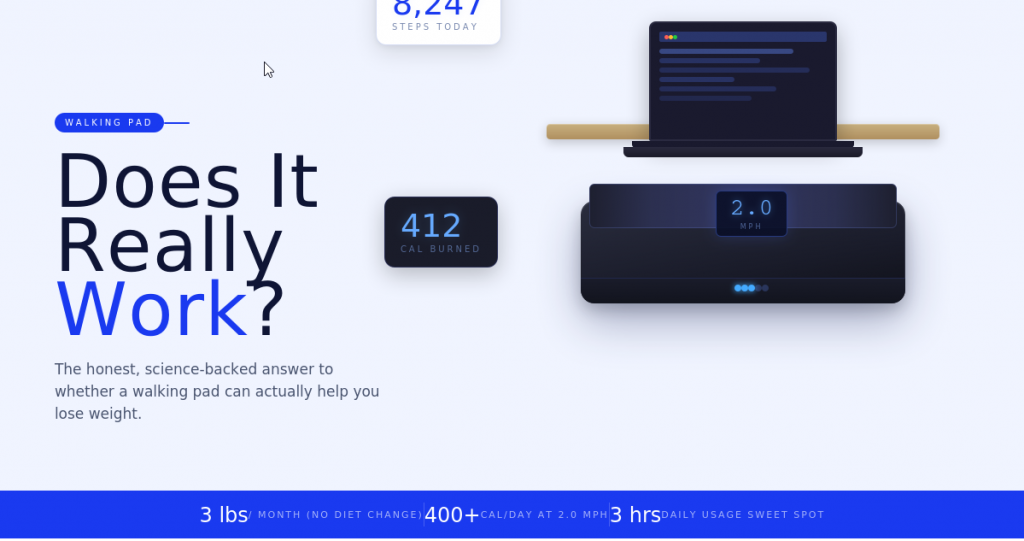

Walking pads — compact, foldable under-desk treadmills designed for slow-speed walking — have exploded in popularity over the past few years. Remote workers, office employees, and anyone who spends most of their day sitting have embraced them as a way to move more without sacrificing productivity. But the critical question is: do walking pads actually help you lose weight, or are they just expensive furniture?
The short answer is yes — but with important caveats. The effectiveness of a walking pad depends on your consistency and walking speed. Furthermore, success relies on how well you integrate movement with your diet and lifestyle.
This comprehensive guide covers everything you need to know about walking pad weight loss: the science, realistic calorie burn figures, an actionable daily routine, and the common mistakes that prevent people from seeing results.
What Is a Walking Pad?
A walking pad (also called an under-desk treadmill or desk treadmill) is a slimmed-down version of a traditional treadmill designed specifically for walking at low speeds — typically 0.5 to 4.0 mph — while working, reading, watching content, or taking calls. Unlike traditional treadmills, walking pads:
- Designed with a slim profile, these units are typically only 4–6 inches thick.
- Storage is simple since they fold flat to fit under beds or sofas.
- Engineered with smaller motors, they prioritize walking speeds over running.
- Operating much more quietly than standard treadmills, they won’t disrupt your calls.
- Range in price from approximately $200 to $800+ depending on quality and features
Popular brands include WalkingPad, Urevo, Goplus, Mobvoi, and LifeSpan — each with varying weight capacities, speed ranges, and connectivity features.
The Science of Walking and Weight Loss
Walking is an aerobic activity that burns calories primarily through increased heart rate and muscle engagement. The calorie-burning equation for walking is straightforward: you burn approximately 80–100 calories per mile, with the exact number depending on your body weight, walking speed, and incline.
However, walking pads introduce a unique dynamic that sets them apart from both regular walking and gym-based cardio: they enable incidental movement during otherwise sedentary time. This is the key mechanism by which walking pads contribute to weight loss.
NEAT: The Game-Changer
As covered in calorie science research, Non-Exercise Activity Thermogenesis (NEAT) — the calories burned through everyday movement outside of formal exercise — can vary by up to 2,000 calories per day between individuals of similar size. People who use walking pads effectively are converting what would otherwise be sedentary desk time into low-intensity physical activity.
Consider this: the average office worker sits for 9–11 hours per day. If they can replace even 3 hours of that sitting time with slow walking on a walking pad, the caloric and metabolic impact is substantial — and it requires no additional time investment in their day.
How Many Calories Does a Walking Pad Actually Burn?
Let’s look at the realistic calorie burn numbers for walking pad use. The figures vary significantly based on walking speed and body weight:
Calories Burned Per Hour on a Walking Pad
At 1.0 mph (very slow walking):
- 120 lb person: ~90 calories/hour
- 150 lb person: ~110 calories/hour
- 180 lb person: ~130 calories/hour
- 220 lb person: ~160 calories/hour
At 2.0 mph (comfortable working pace):
- 120 lb person: ~145 calories/hour
- 150 lb person: ~180 calories/hour
- 180 lb person: ~215 calories/hour
- 220 lb person: ~265 calories/hour
At 3.0 mph (brisk walking pace):
- 120 lb person: ~195 calories/hour
- 150 lb person: ~240 calories/hour
- 180 lb person: ~290 calories/hour
- 220 lb person: ~355 calories/hour
For most people using a walking pad while working, 1.5–2.5 mph is the realistic working sweet spot — fast enough to burn meaningful calories, slow enough to type accurately and maintain focus.
Weekly and Monthly Calorie Projections
A 170-pound person walking on their pad at 2.0 mph for 3 hours per workday (replacing sitting time):
- Per day: approximately 570 calories burned
- Per week (5 workdays): approximately 2,850 calories
- Per month: approximately 11,400 calories
- Fat loss equivalent: approximately 3.25 pounds per month (at 3,500 cal/lb)
That’s over 3 pounds per month of potential fat loss from simply replacing sedentary sitting with slow walking — without changing diet, adding formal workouts, or spending any extra time exercising.
Walking Pad Benefits Beyond Calorie Burning
Weight loss aside, consistent walking pad use delivers a remarkable range of health benefits that make it one of the most impactful lifestyle changes a sedentary person can make:
- Improved insulin sensitivity: Walking at a low intensity after meals significantly reduces blood glucose spikes. Consequently, this improves your insulin response, which is a vital factor for metabolic health.
- Reduced cardiovascular disease risk: Replacing sitting with light walking is independently associated with reduced risk of heart disease, stroke, and all-cause mortality in large epidemiological studies.
- Lower back pain reduction: Prolonged sitting is a primary cause of chronic lower back pain. Alternating between sitting and walking on a pad maintains spinal mobility, hip flexor flexibility, and core engagement.
- Mental clarity and productivity: Multiple studies on “walking meetings” and treadmill desks show improved creative thinking, memory consolidation, and sustained attention during light walking.
- Reduced inflammation: Chronic sedentary behavior elevates systemic inflammatory markers. Regular low-intensity movement throughout the day suppresses inflammation independently of formal exercise.
- Better sleep quality: Increasing total daily movement — even through walking pad use — is associated with improvements in sleep duration and sleep architecture.
Does the Research Support Walking Pad Weight Loss?
While most research on treadmill desks uses studies of traditional walking, the caloric principles apply identically to walking pads. Key research findings:
A 2013 study published in the British Journal of Sports Medicine found that overweight office workers who used treadmill desks lost an average of 1.4 kg (3 lbs) over 12 weeks without any dietary changes — simply by replacing sedentary desk time with slow treadmill walking.
A 2014 study in Obesity tracked employees using treadmill desks for one year and found average weight loss of 1.36 kg (3 lbs), with those who were heavier at baseline losing significantly more. Importantly, these participants were not dieting or following formal exercise programs.
Additional research has documented that standing and walking at a desk increases daily caloric expenditure by 130–170 calories compared to sitting, and that this effect accumulates meaningfully over weeks and months.
Practical Walking Pad Routine for Weight Loss
The difference between people who lose meaningful weight on a walking pad and those who don’t is almost entirely about consistency and how they structure their walking throughout the day. Here’s an effective daily framework:
The 3-Session Workday Method
Morning Session: Start your day on the pad for 45 minutes. During this time, focus on emails or administrative tasks.
Midday Session: Return to the pad after lunch. Because post-meal walking regulates blood glucose, this 30-minute session is highly effective for fat loss.
Afternoon Session: Use the pad to beat the 3 PM slump. In fact, light activity improves alertness better than caffeine.
Total daily walking pad time: 105–150 minutes
Estimated calories burned (170 lb person at 2.0 mph): 400–570 calories
What Tasks Work Best on a Walking Pad?
- Works well: Reading emails, attending audio-only calls, listening to podcasts or audiobooks, watching videos or online courses, replying to simple messages, social media, light web browsing
- Challenging but manageable: Writing emails and documents (may reduce speed slightly), attending video calls (stationary for camera steadiness), data entry
- Avoid on walking pad: Complex calculations, design work, creative writing requiring deep concentration, important video presentations where you need to appear completely still
Optimizing Your Walking Pad Setup
Getting the most out of a walking pad requires the right ergonomic setup:
- Desk height: Use a sit-stand desk or desk converter that raises your workspace to standing height (approximately elbow height when standing). Walking on a pad at sitting desk height forces awkward hunching.
- Monitor position: Eye level or slightly below — typically requiring a monitor arm or laptop stand to elevate the screen.
- Keyboard and mouse: Should be at a height that allows a slight downward elbow angle — this prevents wrist and shoulder tension during extended walking sessions.
- Footwear: Always wear supportive athletic shoes or walking shoes on your pad. Never walk in socks, barefoot, or in flat dress shoes for extended periods — this leads to foot fatigue, plantar fasciitis risk, and knee discomfort.
- Anti-fatigue mat: Consider placing a thin anti-fatigue mat at the end of the walking pad for when you stand still but aren’t walking.
Common Mistakes That Limit Walking Pad Weight Loss
- Using it inconsistently: A walking pad only works for weight loss if used regularly. Many people use theirs intensely for 2–3 weeks and then let it collect dust. Create calendar blocks for walking pad sessions to maintain consistency.
- Compensating by eating more: The “exercise licensing” effect is real — research shows that people often unconsciously eat more after they perceive themselves as being more active. If your diet doesn’t change, weight loss from the pad will be slower than the math suggests.
- Walking too slowly: Under 1.0 mph, calorie burn is minimal and hardly distinguishable from sitting. Push yourself to a pace that creates a light increase in heart rate and breathing — typically 1.5–2.5 mph for most people.
- Expecting rapid weight loss: Walking pad weight loss is gradual — typically 1–3 lbs per month without dietary changes. This is sustainable and meaningful long-term but requires patience.
- Ignoring diet entirely: For maximum results, combine walking pad use with mindful eating. Even small dietary adjustments — reducing liquid calories, increasing protein, cutting out late-night snacking — dramatically accelerate the weight loss effect of the pad.
- Not tracking steps: Connect your walking pad to a fitness tracker or step counter. Seeing your daily step count accumulate is powerful motivation and provides useful data for adjusting your routine.
Walking Pad vs. Traditional Exercise for Weight Loss
A common question is whether a walking pad can replace traditional exercise like running, gym workouts, or fitness classes. The honest answer is: it depends on your goals.
- For general weight loss and health: A walking pad can be a significant contributor to caloric expenditure and fat loss, especially when combined with a reasonable diet. It competes well with many formal cardio programs in terms of total weekly calorie burn when used consistently throughout the workday.
- For building muscle and improving strength: A walking pad provides no resistance training benefit. If body composition improvement is your goal, resistance training is still essential and cannot be replaced by walking.
- For cardiovascular fitness: Slow walking on a pad does not provide sufficient intensity to significantly improve cardiovascular fitness (VO2 max, heart efficiency). Traditional higher-intensity exercise is needed for these adaptations.
- As a complement to exercise: This is where walking pads truly shine. Adding 3 hours of walking pad use to your existing workout routine dramatically increases total daily caloric expenditure without adding any recovery demands or time away from work.
Realistic Weight Loss Expectations from a Walking Pad
To set appropriate goals, you should understand what consistent walking pad use can realistically achieve. Specifically, your results will depend on your starting weight and daily duration.
-
Walking pad use only: You can expect 0.5–2 lbs of weight loss per month. However, this assumes you make no dietary changes and have no other exercise routine.
-
Walking pad + modest diet: Adding a 250-calorie daily reduction can increase results to 1.5–3 lbs per month. Furthermore, this combination is much more sustainable for long-term health.
-
The “Gold Standard” approach: Combining the pad with strength training and high-protein eating can yield 2–4 lbs per month. Consequently, this is the most effective way to improve your body composition.
In fact, many consistent users report losing 15–30 lbs over a single year. Ultimately, these transformative outcomes happen because of low-effort daily habits rather than extreme, short-term diets.
Choosing the Right Walking Pad
If you’re convinced a walking pad is right for you, consider these key purchase factors:
- Weight capacity: Choose a pad rated for at least 30–50 lbs more than your body weight for longevity and motor health
- Belt width: Minimum 16 inches; 18+ inches is more comfortable for natural gait
- Speed range: 0.5–4.0 mph covers all desk-working use cases
- Noise level: Look for models rated under 65 dB for use during calls and meetings
- Connectivity: Bluetooth app connectivity helps track steps, time, distance, and calories burned
- Foldability: A flat-fold design is essential for storage under desks or in closets
Final Thoughts
Walking pads genuinely help you lose weight — but they are not magic. Their power lies in transforming passive sitting time into active calorie burning, accumulating meaningful energy expenditure without requiring any extra hours in your day or visits to a gym.
For remote workers, office professionals, students, or anyone who struggles to find time for traditional exercise, a walking pad represents one of the most practical, sustainable, and evidence-supported tools for increasing daily movement and supporting long-term fat loss.
Use it consistently, walk at a purposeful pace, pair it with mindful eating, and you’ll be surprised by what steady, daily movement can achieve over weeks and months.
Further Reading
- WalkingPad Foldable Treadmill
- Egofit Walker Pro
- Sunny Health Fitness Smart Treadmill
- GOYOUTH Under Desk Treadmill
- UREVO Walking Pad