
AI Is Changing Everything — and Most People Aren’t Prepared
Most people sense that something big is happening. AI tools are replacing tasks that once required years of training. Robotics is moving from factory floors into everyday environments. Jobs that seemed stable are suddenly less certain. The headlines swing between utopian and catastrophic. It’s hard to know what to believe — or how to prepare. Abundance or Collapse by Farzad Mesbahi steps into that uncertainty with a clear framework for thinking about where things are actually headed.
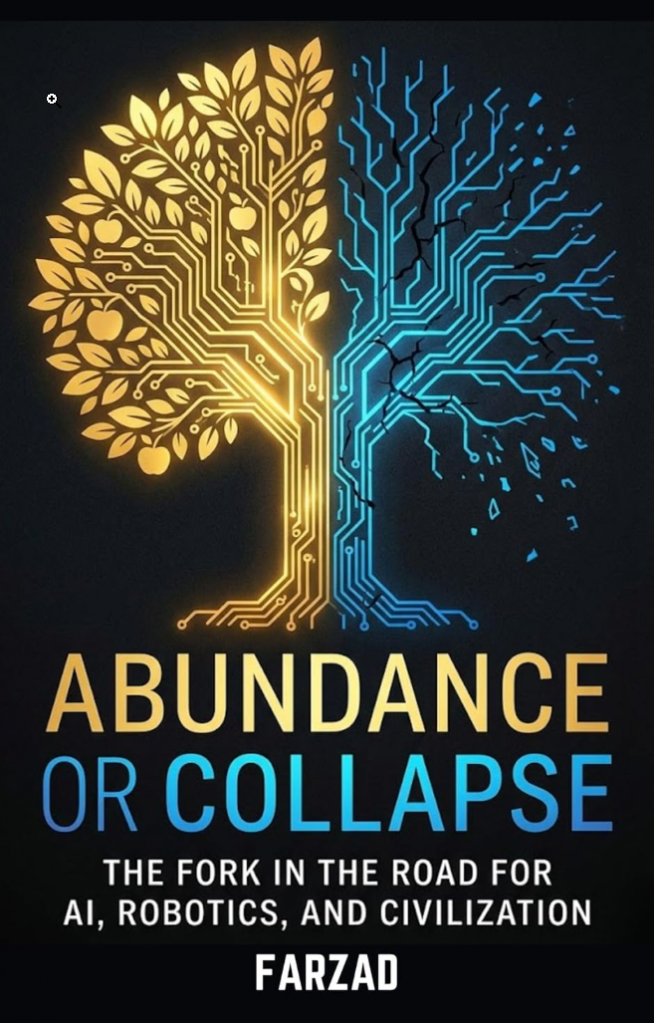
The book doesn’t promise to predict the future. It maps the fork in the road. On one path: a world of material abundance, enabled by AI and automation, where the cost of goods and services drops dramatically. On the other: economic dislocation, political instability, and civilizational collapse — not because the technology failed, but because society failed to adapt to it.
Understanding that choice has direct financial implications. How you invest, what skills you develop, and how you think about economic security all depend on which trajectory you believe is more likely. This review examines whether Mesbahi’s book gives you the tools to make that judgment clearly.
What Is Abundance or Collapse?
Abundance or Collapse: The Fork in the Road for AI, Robotics, and Civilization is a nonfiction analysis by Farzad Mesbahi, a technology strategist and researcher focused on the long-term economic effects of automation. The book examines how AI and robotics are restructuring labor markets, supply chains, and wealth distribution — and what choices at the policy, business, and individual level will determine the outcome.
It is not a technical manual. It does not explain how AI works at the engineering level. Instead, it focuses on consequences — economic, social, and civilizational. The writing is accessible. The argument is structured. It reads less like a prediction and more like a decision framework for thinking about an uncertain future.
- Author: Farzad Mesbahi
- Format: Kindle, Paperback
- Topic: AI, robotics, economic disruption, future of civilization
- Level: General audience — no technical background required
- Best For: Investors, career planners, policy-minded readers, and anyone building long-term financial resilience
Who It’s For
This book is written for people who want to think seriously about the economic future — not just consume headlines about it. The ideal reader is intellectually curious and financially motivated. They want frameworks, not forecasts. They’re trying to understand how AI-driven change will affect their career, their investments, and their long-term financial security.
- Investors trying to understand which sectors and asset classes benefit or suffer from automation trends
- Professionals in white-collar or knowledge-based fields concerned about AI displacement
- Entrepreneurs evaluating where economic opportunity will emerge in an AI-transformed economy
- Policy and civics-minded readers interested in governance responses to technological disruption
- Financial literacy seekers who want context for understanding macroeconomic shifts driven by technology
- Students and early-career workers planning for a labor market that may look very different in a decade
- Anyone who reads about AI regularly but wants a more structured long-form argument rather than articles
- Readers interested in civilizational risk who want analysis grounded in economics rather than science fiction
Key Features
1. A Structured Two-Path Framework for AI’s Economic Future
The book’s core contribution is its binary framework. Mesbahi argues that AI and robotics will not produce a moderate, incremental outcome. The trajectories diverge sharply. Either the productivity gains get distributed broadly — creating material abundance — or they concentrate narrowly, causing the economic and political conditions for collapse.
This framework is useful precisely because it forces clarity. It cuts through the noise of incremental commentary. It asks: which conditions lead to which outcome? That question is more useful for decision-making than vague predictions about AI being “transformative.”
2. Economic Disruption and the Future of Labor
Mesbahi examines how automation affects labor markets across skill levels — not just low-wage physical work, but knowledge work, creative professions, and managerial roles. He analyzes which types of work are most vulnerable and why. This is grounded in current research on task-based economics rather than speculation.
For readers concerned about their own career trajectory, this section provides a useful lens. It doesn’t prescribe which jobs are safe. It teaches you how to evaluate your own exposure to automation risk — a more transferable skill.
3. Wealth Concentration and the Collapse Risk
A significant portion of the book focuses on wealth concentration as the primary risk factor for the collapse scenario. Mesbahi argues that if the gains from AI accrue almost entirely to capital owners — rather than being distributed through wages, public services, or broader economic participation — the social and political consequences become destabilizing.
This has direct relevance to financial literacy. Understanding the relationship between automation, capital returns, and wealth inequality helps investors and savers think more clearly about where value will accrue — and where it will erode.
4. The Abundance Scenario: What It Actually Requires
Mesbahi doesn’t treat abundance as inevitable. He specifies the conditions required for it: broad access to AI tools, policy frameworks that distribute productivity gains, and institutional responses that keep pace with technological change. This is a more rigorous argument than most techno-optimist books offer.
It also makes the book more actionable. If you understand what conditions produce abundance, you can evaluate whether those conditions are being created — and position yourself accordingly as an investor, entrepreneur, or citizen.
5. Robotics as an Economic Force, Not Just a Technology
Mesbahi treats robotics separately from software AI — and for good reason. Physical automation has different economic implications. It affects manufacturing, logistics, agriculture, and healthcare in ways that software automation doesn’t. The book examines how declining robotics costs are accelerating deployment timelines across these sectors.
For investors tracking infrastructure, industrial, or healthcare sectors, this analysis connects technological trends to specific economic effects. That translation from technology to financial implication is one of the book’s most practical contributions.
6. Civilizational Stakes: Why the Outcome Isn’t Guaranteed
The final sections of the book zoom out to civilizational scale. Mesbahi argues that previous technological transitions — industrialization, electrification, the internet — were disruptive but ultimately absorbed. AI and robotics may be different in speed and scope. The institutions that managed past transitions may not be adequate for this one.
This isn’t alarmism for its own sake. It’s a historically grounded argument about why the outcome requires active choices — not passive optimism. For readers thinking about long-term financial and social stability, that argument has real weight.
Honest Pros and Cons
✅ Pros
- The two-path framework gives readers a clear structure for evaluating AI news and economic data going forward
- Accessible writing style requires no background in economics, technology, or policy
- Treats robotics and AI as distinct forces with different economic implications — more nuanced than most popular treatments
- Connects macro trends to practical individual concerns: career risk, investment positioning, economic resilience
- Avoids both uncritical techno-optimism and ungrounded fear — the tone is analytical throughout
- Historically grounded comparisons to previous technological transitions add credibility to the argument
❌ Cons
- Mesbahi is not a household name in economics or AI research — readers may want to cross-reference claims with other sources
- The binary framing, while useful, can oversimplify a landscape with many possible intermediate outcomes
- Policy prescriptions in the book are relatively high-level — readers wanting specific governance solutions may find them thin
- The pace of AI development means some specific claims may date quickly — the framework ages better than the specifics
- Readers outside the United States may find some economic and policy analysis U.S.-centric in its framing
- No detailed investment strategies or personal finance guidance — the book operates at the macro level throughout
How It Compares
vs. The Age of Surveillance Capitalism by Shoshana Zuboff
Zuboff’s book is a more academic, deeply researched examination of how technology platforms extract and monetize human behavioral data. It’s longer, denser, and more focused on the surveillance economy than on AI and robotics as productive forces. Where Mesbahi focuses on economic abundance and collapse as competing futures, Zuboff focuses on power asymmetry and democratic erosion. Both are serious books about technology’s civilizational stakes — but from very different angles and with different audiences in mind.
Bottom line: Zuboff goes deeper on data economics and platform power; Mesbahi is more accessible and focused on automation’s structural economic effects.
vs. The Technology Trap by Carl Benedikt Frey
Frey’s The Technology Trap is a rigorous historical analysis of how technological transitions create winners and losers — often painfully and slowly. It draws on economic history from the Industrial Revolution to make the case that automation disrupts labor markets more violently than textbook economics predicts. It’s more heavily researched than Mesbahi’s book and more cautious in its framing. However, it’s also denser and slower to read. Mesbahi covers similar civilizational concerns with more forward-looking urgency and considerably more accessibility.
Bottom line: Frey is the more scholarly choice; Mesbahi is better suited to readers who want a faster, more action-oriented read on similar themes.
Pricing Breakdown
- Kindle Edition: Typically $4.99–$9.99 (check current Amazon price)
- Paperback: Typically $14.99–$19.99 (check current Amazon price)
- Kindle Unlimited: May be available to read free with an active KU subscription
For a book covering decisions with long-term financial implications, the entry price is low. Check the current price and available formats on Amazon →
Who Should Buy It / Who Should Skip It
Buy It If You:
- Want a structured framework for thinking about AI’s long-term economic consequences
- Are an investor trying to understand which macro trends will shape sector performance over the next decade
- Are in a career that feels exposed to automation and want a clearer way to evaluate that risk
- Follow AI news regularly but want a longer-form argument rather than fragmented takes
- Are building financial literacy and want to understand the macro forces reshaping wealth and labor
- Want a book that treats both optimistic and pessimistic AI futures seriously — without defaulting to either
- Are interested in civilizational risk and want analysis grounded in economics rather than speculation
- Prefer accessible nonfiction that moves quickly without sacrificing intellectual rigor
Skip It If You:
- Want technical explanations of how AI or robotics systems actually work at an engineering level
- Are looking for specific investment strategies or stock recommendations tied to AI trends
- Prefer deeply academic, citation-heavy analysis over an accessible argument-driven narrative
- Want a book focused on personal productivity or career tactics in an AI-augmented workplace
- Are already well-versed in AI economics literature and want cutting-edge research rather than a synthesized overview
- Are looking for personal finance guidance — this book operates at a macro, not individual, level
- Want a non-Western perspective on AI’s economic effects — the framing leans toward developed-economy contexts
- Prefer optimistic, solutions-only narratives without engagement with the risks of getting the transition wrong
Final Verdict
Abundance or Collapse fills a real gap. Most books about AI fall into one of two camps: enthusiastic advocacy or alarmed warning. Mesbahi does something more useful. He builds a framework for evaluating which outcome is more likely given observable conditions. That framework has staying power even as specific AI developments evolve rapidly.
The book is not without limits. It won’t give you a stock portfolio. It won’t give you a five-step career plan. Its policy prescriptions are high-level. And readers who want deep academic rigor will find more of it elsewhere. But for a general reader trying to build a clearer mental model of where the economy is heading — and what’s at stake — it’s a focused and honest contribution.
The financial literacy connection is real. Understanding whether automation will compress costs broadly or concentrate wealth narrowly is directly relevant to investment strategy, career planning, and long-term economic security. Mesbahi makes that argument clearly enough to be genuinely useful.
⭐⭐⭐⭐ (4 out of 5 stars) — A clear-eyed, accessible analysis of AI’s two most plausible economic futures. Recommended for investors, career planners, and anyone trying to think rigorously about what comes next.
→ Get Abundance or Collapse on Amazon and build a clearer framework for navigating the AI economy.
Affiliate Disclosure: This post contains affiliate links. If you purchase through these links, we may earn a small commission at no additional cost to you. We only recommend books and products we believe provide genuine value. This review reflects our honest assessment of the content.