
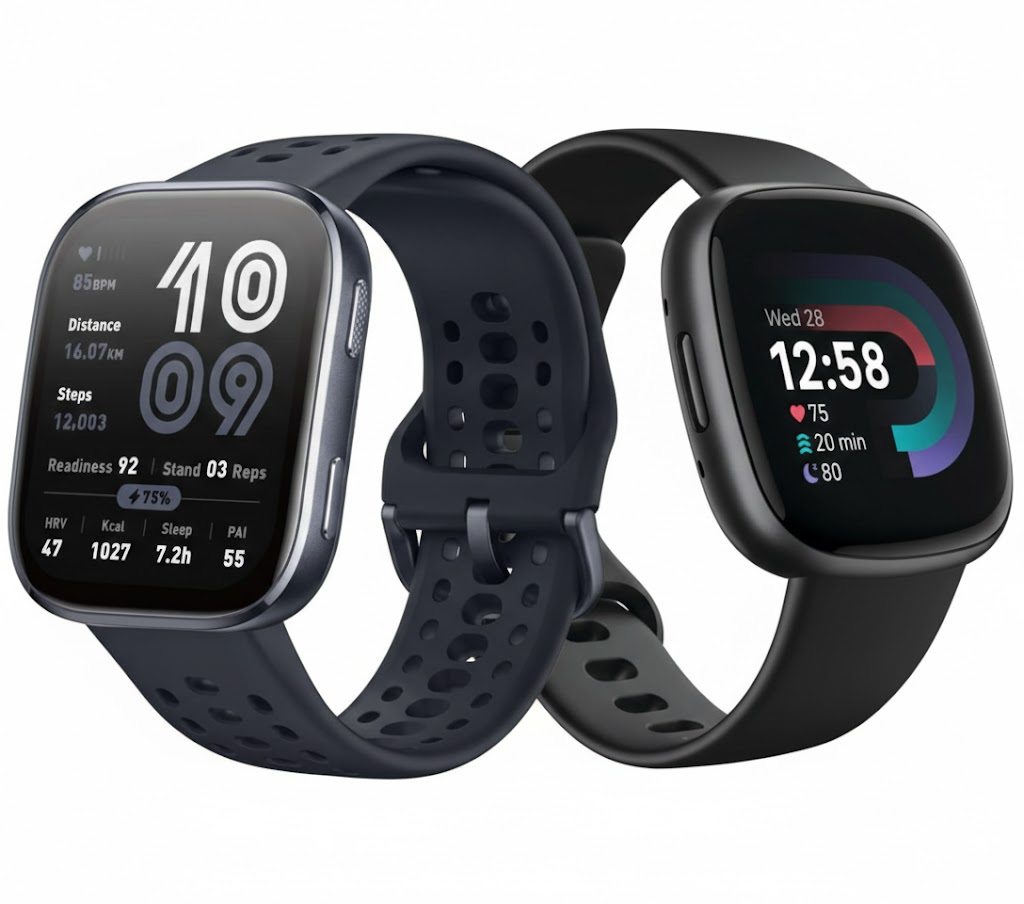

Choosing between the Amazfit Bip 6 and the Fitbit Versa 4 is one of the most common dilemmas in the mid-range smartwatch category — and for good reason. Both are square-faced fitness smartwatches with built-in GPS, AMOLED displays, 5 ATM water resistance, and 24/7 health monitoring. But their philosophies, ecosystems, strengths, and price points differ considerably.
The Amazfit Bip 6 is a 2025 budget powerhouse packed with features that would have cost twice as much just two years ago. The Fitbit Versa 4 is a polished mid-range device backed by Google’s ecosystem with years of refined health tracking software. One prioritizes battery life and raw feature volume at a jaw-dropping price. The other prioritizes data depth, ecosystem integration, and a clean user experience at a higher price point.
In this detailed comparison, we break down every key category so you can make the right call for your specific lifestyle, budget, and fitness goals — without any fluff.
⚡ Quick Verdict Summary
Choose the Amazfit Bip 6 if you want the best feature-per-dollar ratio in smartwatches, industry-leading battery life (up to 14 days), built-in GPS with offline maps, 140+ workout modes, and Bluetooth calling — all for under $80. It’s the clear winner on value, battery longevity, and workout breadth.
Choose the Fitbit Versa 4 if you prioritize a mature, polished health tracking ecosystem, deeper sleep analytics, Google/Fitbit app integration, Fast Charging (a full day in 12 minutes), Daily Readiness Score, and a slightly more premium build feel. It costs significantly more, but the Fitbit platform’s depth and accuracy on wellness metrics justifies the premium for the right user.
Bottom line: The Amazfit Bip 6 wins on specs and value. The Fitbit Versa 4 wins on ecosystem maturity and wellness insight depth. Your choice comes down to budget and priorities.
📊 Full Feature Comparison Table
| Feature | Amazfit Bip 6 46mm | Fitbit Versa 4 |
|---|---|---|
| Release Year | 2025 | 2022 |
| Price (approx.) | ~$79.99 | ~$149–$229 |
| Case Size | 46mm | 40.5mm |
| Display Type | 1.97″ AMOLED, 2,000 nit peak brightness | 1.58″ AMOLED, Always-On Display |
| Display Resolution | 390 x 450px (302 ppi) | 336 x 336px |
| Battery Life | Up to 14 days typical / 26 days saver | Up to 6 days typical / 12 hrs GPS |
| Fast Charging | 1.5–2.5 hours full charge | 12 min = 1 full day of charge |
| GPS | Built-in, 5 satellite systems, offline maps | Built-in GPS |
| Water Resistance | 5 ATM (50m) | 5 ATM (50m) |
| Workout Modes | 140+ (incl. HYROX, strength training, auto-detect) | 40+ exercise modes |
| Heart Rate Monitoring | 24/7 continuous (BioTracker 6.0) | 24/7 continuous |
| Blood Oxygen (SpO2) | Yes | Yes |
| Sleep Tracking | Yes (sleep stages, breathing rate) | Yes (sleep stages, HRV, skin temp, breathing rate) |
| Stress Monitoring | Yes | Yes |
| Daily Readiness Score | No | Yes (Premium feature) |
| ECG | No | No (Sense 2 only) |
| Skin Temperature | No | No (Sense 2 only) |
| Bluetooth Calling | Yes (built-in mic & speaker) | Yes (phone must be nearby) |
| AI Coaching | Yes (personalized AI workout + run plans) | No built-in AI coaching |
| Offline Maps / Navigation | Yes (downloadable maps, turn-by-turn) | No offline maps |
| Voice Assistant | Zepp AI | Amazon Alexa built-in |
| Contactless Pay | NFC (varies by region) | Fitbit Pay / Google Wallet |
| Companion App | Zepp App (iOS & Android) | Fitbit App (iOS & Android) + Google ecosystem |
| Third-Party Apps | Limited | Limited (app gallery stripped on V4) |
| Music Storage/Playback | Music controls only | Music controls only (no local storage) |
| Colors Available | Stone, Red, Charcoal, Black, Blush | Black/Graphite, Blue/Platinum, Pink Sand, Waterfall Blue |
| OS Compatibility | Android & iOS | Android & iOS (better Android integration) |
| Subscription Required | No (Zepp app is free) | Fitbit Premium optional (~$9.99/month) for full features |
🖥️ Display & Design Comparison
Both watches rock a square design and AMOLED screens — but there are meaningful differences worth noting before you buy.
The Amazfit Bip 6 wins on raw display stats: its 1.97-inch AMOLED panel is significantly larger than the Versa 4’s 1.58-inch screen, and its 2,000-nit peak brightness is exceptional — one of the brightest displays available in any budget smartwatch. The display looks vivid indoors and remains readable in direct sunlight, making it one of the best screens available in a budget smartwatch. The 390 x 450 resolution at 302 ppi is sharp and crisp. The 46mm case uses a combination of plastic and aluminum, keeping it lightweight while feeling more premium than its price suggests.
The Fitbit Versa 4 has a smaller 1.58-inch AMOLED display, but it supports an Always-On Display (AOD) mode — something the Bip 6 does not offer. The AMOLED touchscreen is highly responsive, enabling fluid navigation through menus and apps. The Versa 4 is also notably slimmer and lighter: just 24 grams — 15% lighter than the Versa 3 and about 10% thinner. The aluminum case and Gorilla Glass 3 screen cover give it a build quality edge, and for users who prefer a more discreet, fashion-forward wrist presence, the Versa 4’s smaller profile is a genuine advantage.
Winner: Amazfit Bip 6 — for screen size and brightness. Fitbit Versa 4 — for Always-On Display, lighter build, and premium materials.
🔋 Battery Life Comparison
This is one of the most dramatic differentiators between these two devices — and it’s not a close contest.
The Amazfit Bip 6 delivers up to 14 days of battery life in typical use and up to 26 days in battery saver mode. GPS continuous use extends to 32 hours. Real-world testing confirmed approximately 13.2 days for typical mixed use — very close to Amazfit’s claim. Verified buyers consistently report 7–14 days between charges depending on how heavily GPS and health features are used. This is transformative for daily wearability — you can go on a week-long trip and leave the charger at home.
The Fitbit Versa 4 delivers up to 6 days of typical battery life — a solid result for the category but less than half the Bip 6’s stamina. With the always-on display enabled and outdoor GPS workouts, real-world battery life can drop to around two days. The Versa 4 compensates with exceptional fast charging: just 12 minutes plugged in delivers a full day of charge, meaning a short morning charge while you shower keeps you covered.
Winner: Amazfit Bip 6 — by a significant margin on endurance. Fitbit Versa 4 earns a point for superior fast charging speed.
🏃 Fitness & Health Tracking Performance
This is where the two watches diverge most meaningfully in terms of philosophy.
The Amazfit Bip 6 takes a volume approach: 140+ workout modes including HYROX Race and Strength Training, plus personalized AI coaching and 50m water resistance. The BioTracker 6.0 sensor — the same sensor found in Amazfit’s more expensive models — handles heart rate, SpO2, stress, and sleep. The watch includes AI-driven personalized workout plans, rep and set tracking for strength training, and auto-detection of 25 exercise types. Built-in GPS with 5 satellite systems and downloadable offline maps is a feature set you’d typically pay significantly more for. One real-world limitation noted by users: step counting accuracy can be inconsistent, particularly during low-arm-swing activities.
The Fitbit Versa 4 takes a depth approach. It excels in distance precision and its community features foster engagement and motivation. Fitbit’s Daily Readiness Score (Premium) is a sophisticated metric that synthesizes HRV, sleep data, and recent activity to tell you precisely how hard your body is prepared to work on any given day — something the Bip 6 simply doesn’t offer. Sleep tracking captures breathing rate, HRV, skin temperature variation, oxygen saturation, and resting heart rate, with sleep broken down into time spent in various phases. Fitbit’s sleep tracking algorithm is widely regarded as among the most accurate in consumer wearables. The trade-off: only 40+ workout modes versus 140+ on the Bip 6, and heart rate accuracy during high-intensity workouts has drawn criticism from reviewers and independent testers.
Winner: Amazfit Bip 6 — for workout breadth, GPS depth, and offline maps. Fitbit Versa 4 — for sleep tracking accuracy, wellness insight depth, and Daily Readiness Score.
📱 Smart Features & Ecosystem
Smart features are a clear area of distinction between the two watches — and both have notable gaps.
The Amazfit Bip 6 offers Bluetooth calling with a built-in mic and speaker (answer calls directly from your wrist without touching your phone), text notifications, AI workout coaching through the Zepp app, NFC payment in supported regions, weather, and access to 400+ watch faces. The Zepp app is free with no subscription required to access core features. The limitation: the Zepp app ecosystem is less mature than Fitbit’s, and third-party app support is minimal.
The Fitbit Versa 4 benefits from Google ownership: it includes Amazon Alexa built-in, Fitbit Pay, Google Wallet, Google Maps (Android), and Bluetooth calling with text/notification support. It is designed for fitness and beyond — on-wrist Bluetooth calls, texts, phone notifications, customizable clock faces, Fitbit Pay, Amazon Alexa, and Google Wallet and Maps. However, the Fitbit Gallery app store has been stripped of third-party apps on the Versa 4, and there’s no Wi-Fi or music player — both of which were available on the Versa 3. Fitbit’s richest insights are locked behind a Fitbit Premium subscription at $9.99/month, adding ongoing cost.
Winner: Fitbit Versa 4 — for ecosystem depth, Google integration, and Alexa. Amazfit Bip 6 — for no ongoing subscription costs and more capable Bluetooth call hardware.
💰 Price Comparison
| Watch | Launch Price | Current Street Price (approx.) | Subscription Cost | Total First-Year Cost (est.) |
|---|---|---|---|---|
| Amazfit Bip 6 | $79.99 | ~$79.99 | $0 (Zepp app free) | ~$80 |
| Fitbit Versa 4 | $229.95 | ~$149–$179 (discounted) | $0–$119.88/yr (Premium optional) | ~$150–$300 (with Premium) |
The price gap between these two watches is substantial. The Amazfit Bip 6 at $79.99 is less than half the original launch price of the Fitbit Versa 4 — and roughly half the current discounted street price. To unlock Fitbit’s most compelling features (Daily Readiness Score, advanced sleep analytics, personalized coaching), you need Fitbit Premium at $9.99/month — adding up to $119.88 annually. Over a two-year ownership period, a Fitbit Versa 4 with Premium can cost 5–7x the total cost of ownership of an Amazfit Bip 6 with free Zepp app access.
For budget-conscious buyers, this math is decisive. For users who value the Fitbit ecosystem and use Premium features daily, the premium may still be justified.
👉 See the current Amazfit Bip 6 price on Amazon →
👉 See the current Fitbit Versa 4 price on Amazon →
✅ Pros & Cons of Each Watch
Amazfit Bip 6 — Pros & Cons
✅ Pros
- Outstanding value at ~$79.99 — best feature-per-dollar in class
- 14-day battery life (up to 26 days in saver mode)
- Largest, brightest display in its price bracket (1.97″ AMOLED, 2,000 nit)
- 140+ workout modes including HYROX and Strength Training with rep tracking
- Built-in GPS with 5 satellite systems + offline downloadable maps
- Bluetooth calling with built-in mic and speaker
- AI-driven personalized workout plans and marathon training programs
- 24/7 health monitoring: heart rate, SpO2, stress, sleep
- Free Zepp app — no subscription required for core features
- 5 ATM water resistance (swim-safe)
- 400+ watch faces, many free through Zepp app
- Easy band replacement with 3rd party options
❌ Cons
- Step counting accuracy inconsistent during low arm-swing activities
- No Always-On Display mode
- Zepp app ecosystem less mature than Fitbit or Garmin
- No Daily Readiness or recovery score equivalent
- Zepp watch face store has poor search/filter functionality
- No ECG sensor
- Chinese brand — some privacy concerns around data sharing (noted by independent reviewers)
- NFC payment not available in all regions
- No third-party app support
Fitbit Versa 4 — Pros & Cons
✅ Pros
- Mature, trusted Fitbit health tracking ecosystem
- Exceptional sleep tracking — among the most accurate in consumer wearables
- Daily Readiness Score (Premium) — meaningful recovery and training guidance
- Best-in-class fast charging: 12 minutes = 1 full day
- Always-On Display supported
- Google ecosystem integration (Wallet, Maps, Alexa)
- Fitbit Pay for contactless payments
- Lightweight and slim — 24g, 15% lighter than Versa 3
- Gorilla Glass 3 screen protection
- Strong Fitbit community features — challenges, groups, friends leaderboards
- Excellent companion app with food journal and barcode scanner
- HRV tracking during sleep for deeper wellness insight
- Google-backed data privacy and security
❌ Cons
- Significantly more expensive (~$150–$229 vs $80)
- Best features locked behind $9.99/month Fitbit Premium subscription
- Only 40+ workout modes (vs 140+ on Bip 6)
- No offline maps or turn-by-turn navigation
- Heart rate accuracy under-performs competitors during high-intensity exercise
- 3-year-old device with no confirmed successor announced
- Battery drops to 2 days with AOD and GPS active
- Third-party app store removed on Versa 4 (vs Versa 3)
- No local music storage or playback
- No AI workout coaching
🌱 Best for Beginners vs. Advanced Users
Best for Beginners: Fitbit Versa 4
For someone completely new to fitness tracking, the Fitbit Versa 4 has a meaningful advantage: the Fitbit platform’s long history means it has been refined over a decade of user feedback into one of the most intuitive and encouraging fitness experiences available. The Fitbit app interface is clean, the data is presented accessibly rather than technically, and Fitbit’s social features — community challenges, friends leaderboards, and goal-setting tools — are proven motivators for people just starting their health journey. The Daily Readiness Score removes the guesswork about whether you should push hard or rest, which is invaluable when you’re new and haven’t yet learned to read your body’s signals.
The auto-goal adjustment, food journal with barcode scanner, guided programs through Premium, and gentle step reminders make the Fitbit Versa 4 feel like having a friendly, knowledgeable fitness coach on your wrist — not a data dashboard to be decoded.
Best for Advanced Users: Amazfit Bip 6
For athletes, serious hobbyist runners, cyclists, swimmers, gym-goers, and outdoor adventurers, the Amazfit Bip 6 punches dramatically above its price class. The 140+ workout modes, AI-personalized marathon and running plans, HYROX race mode, rep and set tracking for strength training, 5-satellite GPS with offline map downloads, and 32-hour continuous GPS tracking make it a genuinely capable training tool — not just a step counter.
The 14-day battery life is a game-changer for multi-day outdoor expeditions, ultra-marathon events, and adventure racing where charging access is limited. The BioTracker 6.0 sensor — the same sensor in Amazfit’s more expensive flagship models — means you’re getting premium-tier biometric sensing at a budget price. Advanced users who already know how to interpret health data and don’t need a platform to hold their hand will find the Bip 6’s breadth of capability genuinely impressive.
🏆 Final Recommendation: Which Should You Buy?
There is no universally “better” watch between these two — there is only the right watch for your specific situation. Here’s how to make the final call:
Buy the Amazfit Bip 6 if you:
- Have a budget under $100 and want the most features possible for your money
- Prioritize battery life above all else — 14 days is genuinely transformative
- Do a wide variety of sports and want 140+ workout modes
- Need GPS navigation and offline maps for hiking, running, or cycling routes
- Want Bluetooth calling directly from your wrist
- Don’t want to pay a monthly subscription to access watch features
- Are an outdoor adventurer, serious athlete, or data-forward fitness user
Buy the Fitbit Versa 4 if you:
- Are new to fitness tracking and want the most encouraging, beginner-friendly platform
- Already use the Fitbit or Google ecosystem and want seamless integration
- Prioritize sleep tracking depth and wellness insight quality over workout breadth
- Value fast charging — 12 minutes for a full day’s charge is genuinely useful
- Want Google Wallet, Fitbit Pay, Alexa, and Google Maps on your wrist
- Prefer a lighter, slimmer watch with an Always-On Display option
- Are comfortable with a subscription model and value Daily Readiness coaching
Disclosure: This post contains affiliate links. If you purchase through our links, we may earn a small commission at no extra cost to you. All opinions and comparisons are independent and based on verified product specifications, expert reviews, and real customer feedback.
Frequently Asked Questions
Is the Amazfit Bip 6 better than the Fitbit Versa 4?
The Amazfit Bip 6 is better on battery life, display size, workout modes, GPS capability, and price. The Fitbit Versa 4 is better on sleep tracking depth, ecosystem maturity, fast charging, Always-On Display, and wellness insight quality. Neither is universally better — the right pick depends entirely on your priorities and budget.
Does the Amazfit Bip 6 have better battery life than the Fitbit Versa 4?
Yes — significantly. The Amazfit Bip 6 delivers up to 14 days of typical battery life (26 days in saver mode) compared to the Fitbit Versa 4’s up to 6 days. In real-world GPS-heavy use, the Versa 4 can drop to approximately 2 days, while the Bip 6 holds up for many days even with active tracking enabled.
Can the Amazfit Bip 6 make phone calls?
Yes. The Amazfit Bip 6 has a built-in microphone and speaker for Bluetooth calling — you can answer and make calls directly from your wrist when your phone is nearby. The Fitbit Versa 4 also supports Bluetooth calls, but requires the phone to be nearby.
Does the Fitbit Versa 4 require a subscription?
Basic fitness tracking on the Fitbit Versa 4 is free. However, Fitbit’s most valuable features — Daily Readiness Score, advanced sleep analysis, personalized insights, and guided programs — require a Fitbit Premium subscription at approximately $9.99/month. The Amazfit Bip 6’s Zepp app is free with no subscription needed for core features.
Which smartwatch is better for outdoor activities?
The Amazfit Bip 6 is the stronger choice for outdoor activities. It offers 5-satellite GPS, downloadable offline maps, turn-by-turn navigation, 32 hours of continuous GPS battery life, and 140+ workout modes. The Fitbit Versa 4 has built-in GPS but no offline maps or navigation capabilities.
Which is better for sleep tracking — Amazfit Bip 6 or Fitbit Versa 4?
The Fitbit Versa 4 is widely regarded as the superior sleep tracker. It captures HRV, skin temperature variation, breathing rate, oxygen saturation, and detailed sleep phase analysis — and Fitbit’s sleep algorithms have been refined over years of real-world use. The Amazfit Bip 6 provides good sleep tracking, but the depth and accuracy of Fitbit’s sleep data remains an industry benchmark.
Is the Amazfit Bip 6 worth buying in 2025?
Absolutely. The Amazfit Bip 6 is a 2025 release with cutting-edge features at a sub-$80 price point. The AMOLED display, BioTracker 6.0 sensor, 5-satellite GPS with offline maps, 140+ workout modes, AI coaching, and 14-day battery represent a feature set that was simply not available at this price before 2025. It is one of the best value smartwatches on the market today.