
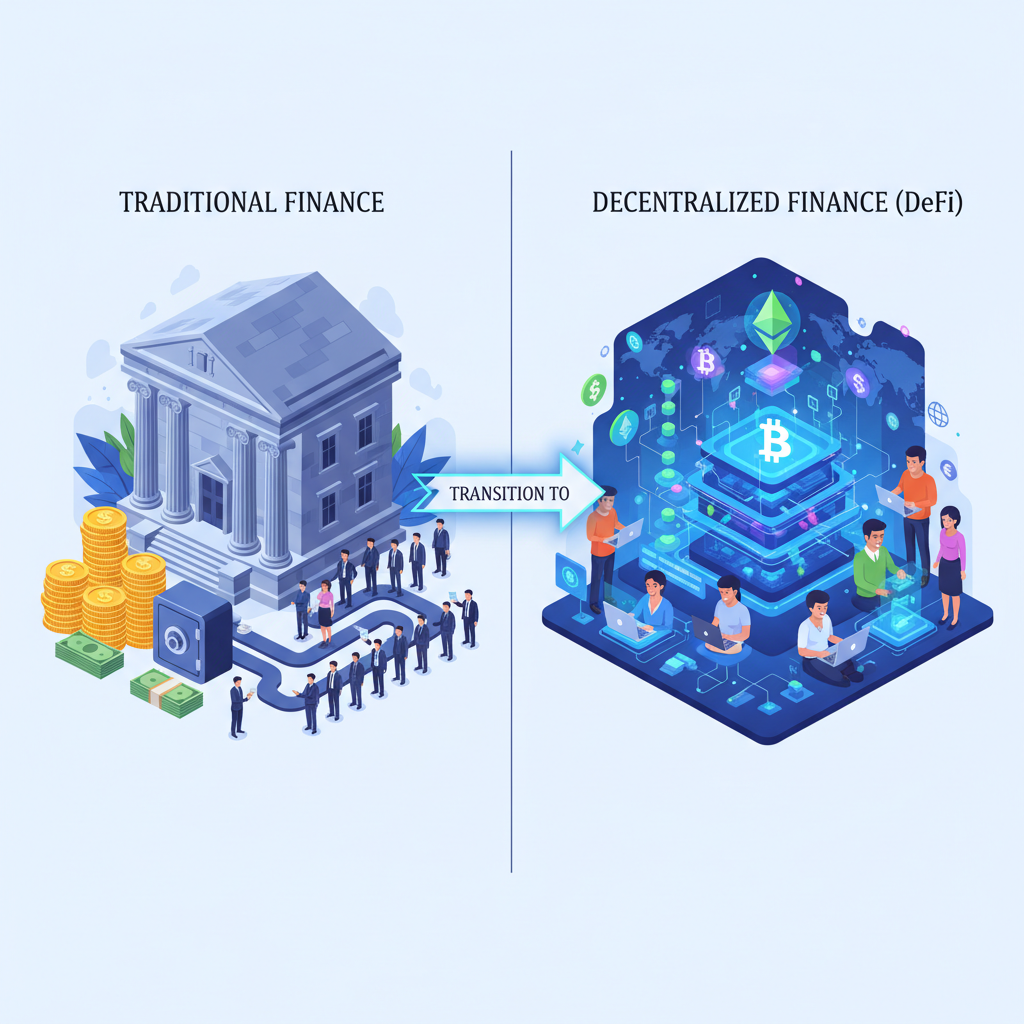

Did you know that the global financial market is valued at over $250 trillion? For centuries, traditional finance has been the backbone of our economy, offering services like lending, borrowing, and investing. However, this system often comes with barriers, including high fees, slow transaction times, and limited accessibility for many. Imagine a world where financial services are open to anyone with an internet connection, offering greater control and potentially lower costs. This is the promise of Decentralized Finance, or DeFi.
DeFi is a rapidly evolving sector within the cryptocurrency space. It aims to recreate and improve upon traditional financial systems, such as banks, exchanges, and insurance companies, using blockchain technology. Instead of relying on intermediaries like banks, DeFi platforms operate on smart contracts. These are self-executing contracts with the terms of the agreement directly written into code. They run on blockchains, most commonly Ethereum, and automate financial transactions without the need for central authorities.
This guide will demystyfy DeFi, explaining its core concepts, how it works, its benefits, risks, and what the future might hold. Whether you’re a seasoned crypto enthusiast or completely new to the space, understanding DeFi is becoming increasingly important in our digital age.
Understanding the Core Principles of DeFi
At its heart, DeFi is built on a few fundamental principles that differentiate it from traditional finance. These principles are crucial for grasping the “why” behind this new financial paradigm.
First and foremost is decentralization. Unlike traditional banks or financial institutions that operate under a central authority, DeFi platforms distribute control across a network of users. This means no single entity can unilaterally change rules, censor transactions, or shut down services. This distributed nature is powered by blockchain technology, which acts as a public, immutable ledger.
Secondly, transparency is a key tenet. Because DeFi operates on public blockchains, all transactions are recorded and verifiable by anyone. While user identities are often pseudonymous (represented by wallet addresses), the flow of funds and the execution of smart contracts are open for inspection. This level of transparency is unparalleled in traditional finance, where many operations are opaque.
Openness and accessibility are also paramount. DeFi aims to be permissionless, meaning anyone with an internet connection and a compatible crypto wallet can access its services. There are no lengthy application processes, credit checks, or geographical restrictions that often gatekeep traditional financial products. Therefore, this inclusivity has the potential to empower the unbanked and underbanked populations worldwide.
Finally, composability is a unique characteristic of DeFi. Think of DeFi protocols as building blocks. Developers can combine different DeFi applications to create new, innovative financial products and services. This “money legos” approach allows for rapid innovation and the creation of complex financial strategies that would be difficult or impossible to replicate in the traditional financial world. Consequently, new use cases and platforms emerge at an astonishing pace.
How Does DeFi Actually Work?
DeFi leverages several key technological components to function. The most important of these is blockchain technology. Blockchains provide a secure, decentralized, and transparent ledger for all transactions. They ensure that once a transaction is recorded, it cannot be altered or deleted, which builds trust and immutability.
The dominant blockchain for DeFi is Ethereum, though others like Binance Smart Chain, Solana, and Polygon are also gaining traction. Ethereum’s smart contract functionality is what enables DeFi to exist. These self-executing contracts automatically enforce the terms of agreements, eliminating the need for intermediaries. For example, a lending smart contract can automatically disburse loan payments or liquidate collateral if a borrower defaults, all without human intervention.
Cryptocurrencies are the lifeblood of DeFi. They serve multiple purposes: as a medium of exchange, as collateral for loans, and as a way to earn interest. Stablecoins, a type of cryptocurrency pegged to a stable asset like the US dollar (e.g., USDC, DAI), are particularly important in DeFi as they minimize the price volatility often associated with other cryptocurrencies.
Decentralized Applications (dApps) are the user interfaces that allow people to interact with DeFi protocols. These are built on top of blockchains and are powered by smart contracts. Users typically interact with dApps through a cryptocurrency wallet, like MetaMask, which acts as their gateway to the DeFi ecosystem. Moreover, these wallets allow users to manage their assets and sign transactions.
Oracles play a critical role by connecting smart contracts to real-world data. Since blockchains are isolated systems, smart contracts need a reliable way to access external information, such as current market prices for assets. Oracles act as trusted data feeds, ensuring that smart contracts can make accurate decisions based on real-world events. Chainlink is a prominent example of an oracle network.
Decentralized Exchanges (DEXs) are a cornerstone of DeFi. Unlike centralized exchanges (CEXs) where users deposit funds and trade through a company’s order book, DEXs allow users to trade directly with each other using smart contracts. They often employ Automated Market Makers (AMMs), which use liquidity pools and algorithms to determine asset prices, rather than traditional order books.
Key DeFi Applications and Use Cases
The DeFi ecosystem is vast and constantly expanding, offering a wide array of financial services. Understanding these core applications will give you a clearer picture of DeFi’s potential.
1. Decentralized Exchanges (DEXs)
As mentioned, DEXs enable peer-to-peer trading of cryptocurrencies without intermediaries. Popular examples include Uniswap, Sushiswap, and PancakeSwap. Users trade directly from their wallets, maintaining custody of their assets throughout the process. This contrasts sharply with centralized exchanges, where users entrust their funds to the exchange operator. Therefore, DEXs offer greater security in terms of asset ownership.
2. Lending and Borrowing Platforms
DeFi platforms allow users to lend their crypto assets to earn interest or borrow assets by providing collateral. Platforms like Aave and Compound facilitate this process. Lenders deposit their crypto into liquidity pools, and borrowers can then take loans from these pools, typically by over-collateralizing their loans with other crypto assets. Interest rates are often determined algorithmically based on supply and demand. Furthermore, this creates a more efficient market for capital.
3. Stablecoins
Stablecoins are cryptocurrencies designed to maintain a stable value, usually pegged to a fiat currency like the US dollar. Examples include USDC, Tether (USDT), and DAI. They are crucial for DeFi because they offer a less volatile medium of exchange and a reliable store of value within the often-turbulent crypto markets. DAI, for instance, is a decentralized stablecoin backed by crypto collateral through a system managed by smart contracts.
4. Yield Farming and Liquidity Mining
These are strategies where users provide liquidity to DeFi protocols (like DEXs or lending platforms) in exchange for rewards. Yield farming involves seeking out the highest possible returns on crypto assets, often by moving funds between different protocols. Liquidity mining is a specific form of yield farming where protocols incentivize users to provide liquidity by distributing their native tokens as rewards. Consequently, this helps bootstrap new DeFi projects and encourages participation.
5. Insurance
Decentralized insurance protocols aim to offer coverage against smart contract failures, stablecoin de-pegging, or other risks within the DeFi ecosystem. Platforms like Nexus Mutual allow users to pool funds to underwrite insurance policies, providing a decentralized alternative to traditional insurance providers. Additionally, this is a critical area for building trust and mitigating risk in DeFi.
6. Derivatives and Synthetics
DeFi is enabling the creation and trading of complex financial instruments like options, futures, and synthetic assets. Synthetic assets allow users to gain exposure to the price of real-world assets, such as stocks or commodities, using cryptocurrency. Protocols like Synthetix are at the forefront of this innovation.
Benefits of DeFi
The appeal of DeFi lies in its potential to revolutionize financial services. Several key benefits contribute to its growing popularity.
Increased Accessibility and Financial Inclusion
Perhaps the most significant benefit is DeFi’s ability to provide access to financial services for anyone with an internet connection. Traditional finance often excludes individuals due to geographical location, lack of credit history, or high minimum deposit requirements. DeFi bypasses these barriers, potentially empowering billions of people globally. Moreover, this opens up opportunities for economic growth and stability in underserved regions.
Greater Control and Ownership
In DeFi, users retain full control over their assets. Unlike traditional banking where your money is held by the institution, in DeFi, you interact with protocols directly from your own non-custodial wallet. This means you hold the private keys to your funds, giving you complete ownership and preventing third parties from freezing or seizing your assets. Therefore, users experience a level of financial sovereignty previously unavailable.
Transparency and Security
The use of blockchain technology ensures that all transactions and protocol operations are transparent and immutable. This open ledger system reduces the potential for fraud and manipulation. While smart contracts can have vulnerabilities, the underlying blockchain is generally very secure. Consequently, users can verify transactions and understand how protocols operate, fostering trust.
Efficiency and Lower Costs
By eliminating intermediaries, DeFi can significantly reduce transaction fees and processing times. Automated smart contracts handle processes that would typically require human intervention and associated costs in traditional finance. This can lead to more efficient markets and lower costs for consumers. For example, international money transfers can become much cheaper and faster.
Innovation and Composability
The “money legos” nature of DeFi allows for rapid innovation. Developers can build new applications by combining existing protocols, leading to a vibrant and dynamic ecosystem. This fosters creativity and enables the development of novel financial products and services tailored to specific needs. Additionally, this constant evolution pushes the boundaries of what’s possible in finance.
Risks and Challenges of DeFi
Despite its promising benefits, DeFi is not without its risks and challenges. It’s crucial for users to understand these potential pitfalls before engaging with DeFi.
Smart Contract Vulnerabilities and Exploits
Smart contracts, while powerful, are code and can contain bugs or security flaws. Malicious actors can exploit these vulnerabilities to drain funds from protocols. Numerous high-profile hacks have resulted in millions of dollars in losses. However, the DeFi community is actively working on improving smart contract security through audits and formal verification.
Volatility
The prices of many cryptocurrencies, especially those used as collateral or for rewards in DeFi, can be highly volatile. This volatility can lead to significant losses for users, particularly in lending and borrowing scenarios where under-collateralized positions can be liquidated. Therefore, managing risk through diversification and understanding collateralization ratios is essential.
Regulatory Uncertainty
The regulatory landscape for DeFi is still evolving and varies significantly across different jurisdictions. Governments are grappling with how to regulate decentralized financial activities, which could lead to future restrictions or requirements that impact DeFi protocols and users. Consequently, regulatory changes could significantly alter the DeFi space.
User Experience and Complexity
Interacting with DeFi protocols often requires a certain level of technical understanding. Setting up wallets, managing private keys, understanding gas fees, and navigating different dApps can be daunting for beginners. The user experience is improving, but it remains a significant barrier to mainstream adoption. Moreover, steep learning curves deter many potential users.
Impermanent Loss
This is a risk specific to providing liquidity in AMM-based DEXs. Impermanent loss occurs when the price ratio of the two assets in a liquidity pool changes compared to when they were deposited. While the user still earns trading fees, they might end up with less value than if they had simply held the assets separately. However, this risk is mitigated by strong trading volume and price stability within the pool.
Oracle Risks
As mentioned earlier, oracles provide external data to smart contracts. If an oracle is compromised or provides inaccurate data, it can lead to incorrect execution of smart contracts and potential financial losses. Relying on secure and decentralized oracle solutions is critical.
The Future of DeFi
The trajectory of DeFi suggests a future where it plays an increasingly significant role in the global financial landscape. Several trends point towards its continued growth and evolution.
One major trend is the institutional adoption of DeFi. While still in its early stages, traditional financial institutions are beginning to explore DeFi opportunities, either by investing in DeFi projects, offering DeFi-related services, or building their own blockchain-based financial infrastructure. This could bring significant capital and legitimacy to the space.
Another key development is the scaling of blockchains. As more users and transactions enter the DeFi ecosystem, the underlying blockchains face scalability challenges, leading to high transaction fees (gas fees) and slow confirmation times, particularly on Ethereum. Solutions like Layer 2 scaling (e.g., Polygon, Arbitrum, Optimism) are being developed and implemented to address these issues, making DeFi more efficient and affordable. Furthermore, these scaling solutions are crucial for mass adoption.
Interoperability between different blockchains is also becoming increasingly important. Currently, many DeFi applications are siloed on specific blockchains. Solutions that allow assets and data to move seamlessly between different blockchains (cross-chain bridges) will unlock new possibilities and create a more connected DeFi ecosystem.
Furthermore, we can expect to see increased regulatory clarity. As governments and regulatory bodies become more familiar with DeFi, they will likely implement clearer frameworks. While this might introduce some restrictions, it could also provide a more stable and predictable environment for DeFi to thrive, attracting more mainstream users and businesses.
Finally, the convergence of CeFi and DeFi might occur. Instead of a complete replacement, we might see traditional finance (CeFi) integrating aspects of DeFi, and DeFi protocols adopting some CeFi-like features for enhanced user experience or compliance. This hybrid model could offer the best of both worlds.
Getting Started with DeFi
If you’re interested in exploring DeFi, here’s a basic roadmap:
- Acquire Cryptocurrency: You’ll need some cryptocurrency, typically Ether (ETH) if you’re using the Ethereum network, to start. You can buy crypto on centralized exchanges like Coinbase or Binance.
- Set Up a Wallet: Download a non-custodial crypto wallet like MetaMask, Trust Wallet, or Phantom (for Solana). Crucially, secure your wallet’s seed phrase – this is your backup and should never be shared.
- Fund Your Wallet: Transfer your acquired cryptocurrency from the exchange to your new crypto wallet.
- Connect to dApps: Visit DeFi websites (like Uniswap, Aave, Compound) and connect your wallet. You’ll usually find a “Connect Wallet” button.
- Start Exploring: Begin with simpler applications like swapping tokens on a DEX or depositing funds into a lending protocol. Always start with small amounts you can afford to lose as you learn.
- Understand Gas Fees: Transactions on blockchains like Ethereum require “gas fees,” which are paid to network validators. These fees can fluctuate based on network congestion.
Remember, always do your own research (DYOR) before interacting with any DeFi protocol. Understand the risks involved and never invest more than you can afford to lose.
Conclusion
Decentralized Finance, or DeFi, represents a paradigm shift in how we think about and interact with financial services. By leveraging blockchain technology and smart contracts, DeFi aims to create a more open, accessible, transparent, and efficient financial system. It offers compelling alternatives to traditional finance, from decentralized exchanges and lending platforms to stablecoins and insurance.
While the potential benefits are immense, including greater financial inclusion and user control, it’s vital to acknowledge the inherent risks. Smart contract vulnerabilities, market volatility, and regulatory uncertainty are significant challenges that the DeFi space continues to address.
As the technology matures, scalability solutions improve, and regulatory frameworks become clearer, DeFi is poised for further growth and innovation. For individuals seeking greater financial autonomy and access to a wider range of financial tools, understanding and cautiously exploring DeFi could unlock new opportunities in the evolving digital economy. The journey into DeFi requires education, careful risk management, and a commitment to continuous learning, but the potential rewards are substantial.
Frequently Asked Questions (FAQ)
Q1: Is DeFi safe?
DeFi carries inherent risks. While the underlying blockchain technology is secure, smart contracts can have vulnerabilities that lead to exploits and loss of funds. Additionally, market volatility and regulatory changes pose significant risks. It’s crucial to understand these risks and take precautions, such as using audited protocols and starting with small amounts.
Q2: What is the difference between DeFi and traditional finance (CeFi)?
The primary difference lies in decentralization. Traditional finance relies on intermediaries like banks and brokers, operating under central authorities. DeFi, on the other hand, uses blockchain and smart contracts to enable peer-to-peer transactions without intermediaries, offering greater transparency and user control.
Q3: What are gas fees in DeFi?
Gas fees are transaction fees paid to network validators or miners to process transactions on a blockchain, such as Ethereum. These fees compensate them for their work in securing the network and executing smart contracts. Gas fees can vary significantly depending on network congestion.
Q4: Can I lose money in DeFi?
Yes, you can absolutely lose money in DeFi. Risks include smart contract hacks, market volatility leading to liquidation of collateral, impermanent loss when providing liquidity, and potential regulatory actions. It is essential to approach DeFi with caution and only invest what you can afford to lose.
Q5: Do I need to be a programmer to use DeFi?
No, you do not need to be a programmer to use DeFi. While understanding the underlying technology is beneficial, interacting with DeFi applications is typically done through user-friendly interfaces and crypto wallets. However, a basic understanding of how crypto wallets and transactions work is recommended.
Q6: What is the most popular DeFi application?
Popularity can be measured in various ways (e.g., total value locked, number of users). However, some of the most prominent and widely used DeFi applications include decentralized exchanges like Uniswap and PancakeSwap, lending protocols like Aave and Compound, and stablecoin issuers like MakerDAO (for DAI).