
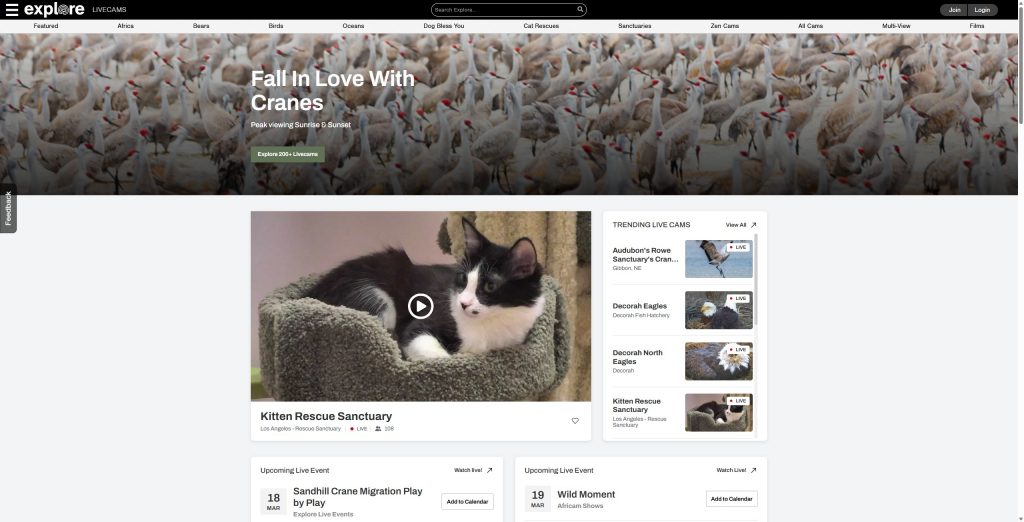

At this moment, brown bears are catching salmon at Brooks Falls in Katmai National Park. Bald eagles are feeding their chicks in a nest somewhere in Iowa. At a waterhole in the Madikwe Game Reserve in South Africa, giraffes and elephants are arriving in the late afternoon light. All of this is happening live, in real time, on camera — and you can watch any of it from your desk for free, no account required, with no advertising interrupting the feed.
That’s explore.org. And describing it as a “wildlife cam website” genuinely undersells what it is. It’s a philanthropic live streaming network operated by the Annenberg Foundation, running over 150 cameras across ecosystems around the world, 24 hours a day, as a free public resource. It’s one of those rare internet destinations that doesn’t want anything from you — not your data, not your subscription, not your attention for advertising purposes. It just streams the world.
The Scale of What explore.org Has Built
explore.org is the philanthropic multimedia division of the Annenberg Foundation — one of the most significant private foundations in American public life, historically focused on education, journalism, and public service. The nature cam network is one of their ongoing digital projects: a live streaming infrastructure connecting cameras in remote and protected habitats across multiple continents, delivered to a global online audience at no cost.
The operational scope is significant. Video feeds are transported into AWS cloud infrastructure, processed through professional broadcast systems, and delivered to viewers simultaneously across multiple platforms. In some remote locations — like the Gorilla Sanctuary in the Democratic Republic of Congo — the connectivity infrastructure required to transmit a live feed is itself a technological challenge. The fact that most of this operates invisibly behind a clean browser interface is a function of serious engineering and significant ongoing investment.
None of that cost is passed to the viewer. The mission statement is explicit: inspire lifelong learning and connect people with the natural world, at no charge, in service of conservation awareness.
What You’ll Actually Find on the Site
Live Cams by Habitat and Animal
The camera network spans African savannahs and waterholes, Alaskan national parks during salmon season, bird nests during breeding and hatching, marine environments including manatee springs and underwater reef cams, puppy and kitten foster programs, northern lights cams in the Arctic, and urban wildlife in surprising places.
The most-watched feeds tend to be the ones tied to seasons and events: brown bears at Brooks Falls during the sockeye salmon run, bald eagle nests during egg incubation and chick development, polar bear cams during migration season. The seasonal rhythm means the platform is consistently interesting across the entire year — there’s always something happening on some camera somewhere.
The African Wildlife Cam Network
A significant portion of the camera network is dedicated to African wildlife, with cameras at waterholes and game reserves in South Africa, Kenya, and other locations. Waterholes are particularly compelling for live viewing — they’re natural focal points where diverse animals converge on predictable schedules, and camera operators can remotely reposition cameras to follow specific animals.
The Mpala Research Centre cameras in Kenya include multiple feeds — a waterhole cam, a river cam, and a safari-style wide view — operated in partnership with active conservation research programs.
Educational Films and Documentaries
Beyond live streams, explore.org hosts a library of documentary films covering wildlife conservation, environmental science, and natural history. These are curated for educational use and cover topics from polar bear conservation to deep ocean research. The films are free to watch and suitable for classroom use, which makes the site genuinely useful for educators at multiple grade levels.
Highlight Clips and Snapshots
Because the cameras run 24/7, most of the best moments happen when no one is specifically watching. The platform captures highlights — significant events, unexpected animal behaviors, rare sightings — as shareable clips. The snapshot feature also allows viewers to capture and share a still from any live feed, which has created an engaged community of wildlife photographers who monitor cams specifically to capture unusual moments.
Who Watches explore.org — and Why They Keep Coming Back
- Nature and wildlife enthusiasts who want a live, unscripted window into animal behavior
- Teachers and homeschool educators who use live cams as real-time science and nature study
- People who use the cams as ambient, calming background content — a living alternative to a screensaver
- Wildlife photographers who monitor feeds for snapshot opportunities during rare behavioral events
- Conservation supporters who want to feel connected to the causes and habitats they care about
- Anyone going through a stressful period who finds genuine comfort in watching unhurried natural processes
- Families with young children who are curious about specific animals and want to see them live
- People who follow specific cams seasonally — the bears, the eagles, the gorillas — like returning to a favorite story
What Works and What Has Room to Improve
✅ What Makes explore.org Exceptional
- Completely free with no subscription, no account required to watch, and no advertising interrupting live feeds
- Camera network is global and genuinely diverse — African wildlife, North American raptors, Arctic conditions, marine environments
- 24/7 operation means something is always live, in every time zone
- Stream quality is high — the AWS broadcast infrastructure delivers reliable, clear video
- Educational film library is substantial and appropriate for formal classroom use
- Backed by serious philanthropic infrastructure — this isn’t a side project, it’s an institutional commitment
- The seasonal dimension creates compelling reasons to return throughout the year
❌ Where It Could Be Better
- Some cameras show dormant or empty habitats for extended periods — active sighting frequency varies significantly by location and time of day
- The browsing interface has improved but still requires some navigation patience to find specific animals or regions
- Not all cameras have audio — some locations stream silent video only, which reduces immersion
- Seasonal cams go offline outside their peak period, which can disappoint viewers who discover them after the season
- Community features are present but relatively limited compared to more social wildlife platforms
- African cam timing can be challenging for North American viewers — peak activity hours align with inconvenient timezones
How explore.org Compares
vs. National Park Service Webcams
The US National Park Service operates webcams at many parks — Yellowstone geysers, Grand Canyon rim views, volcano monitoring in Hawaii. These are free, reliable, and tied to iconic places. But NPS cameras are largely landscape-focused rather than wildlife-focused, and the broadcasting infrastructure is basic compared to explore.org’s production quality. For immersive wildlife viewing rather than scenic views, explore.org is the better platform by a significant margin. Bottom line: NPS cams for iconic landscapes; explore.org for live animal watching with broadcast-quality streams.
vs. YouTube Wildlife Live Streams
YouTube hosts many nature live streams — some operated by zoos, some by wildlife organizations, some by individual operators. The quality and reliability varies enormously. YouTube’s recommendation algorithm also surfaces advertising and unrelated content around live streams. explore.org’s curated network, institutional backing, and ad-free presentation make it a cleaner, more trustworthy experience for both casual viewers and educators. The difference in infrastructure reliability is meaningful for classroom use. Bottom line: YouTube for variety and discoverability; explore.org for reliability, curation, and an ad-free environment appropriate for educational settings.
Access, Cost, and the App
- Website viewing: Free — no account required
- Mobile app (iOS and Android): Free — includes all live cams, favorites, snapshot, and sharing features
- Account creation: Optional — unlocks favorites, personalized cam lists, and sharing history
- Advertising: Not present on live feeds — the platform is philanthropy-funded, not ad-supported
- Donation/support: Optional — the platform accepts charitable contributions in support of the Annenberg Foundation’s conservation mission
There’s nothing to set up and nothing to pay. Open explore.org right now — a waterhole somewhere is probably busy →
Final Verdict
explore.org is one of those sites that is harder to describe than it is to simply show someone. The explanation — “it’s a live wildlife cam network” — doesn’t capture what it feels like to have it open in the background on a Tuesday afternoon while a family of elephants moves through frame at a South African waterhole.
There’s something genuinely restorative about it. The world is happening whether or not you’re watching. The bears don’t know you exist. The eagles aren’t performing for the camera. It’s just real life in a habitat you’ll probably never visit, being shared freely by an institution that believes connecting people to the natural world is worth doing for its own sake.
That’s a remarkable thing to have on the internet. Use it.
Rating: 5 / 5 stars — A genuinely exceptional free resource. One of the best things on the internet for anyone who wants an authentic, unmediated connection to the natural world. Bookmark it, put it on your second monitor, and share it with a teacher. Watch live at explore.org →
Disclosure: This article includes affiliate links. We may earn a commission if you click and take action. Our assessments are entirely independent — explore.org is a nonprofit-backed platform with no commercial relationship to our editorial work.