
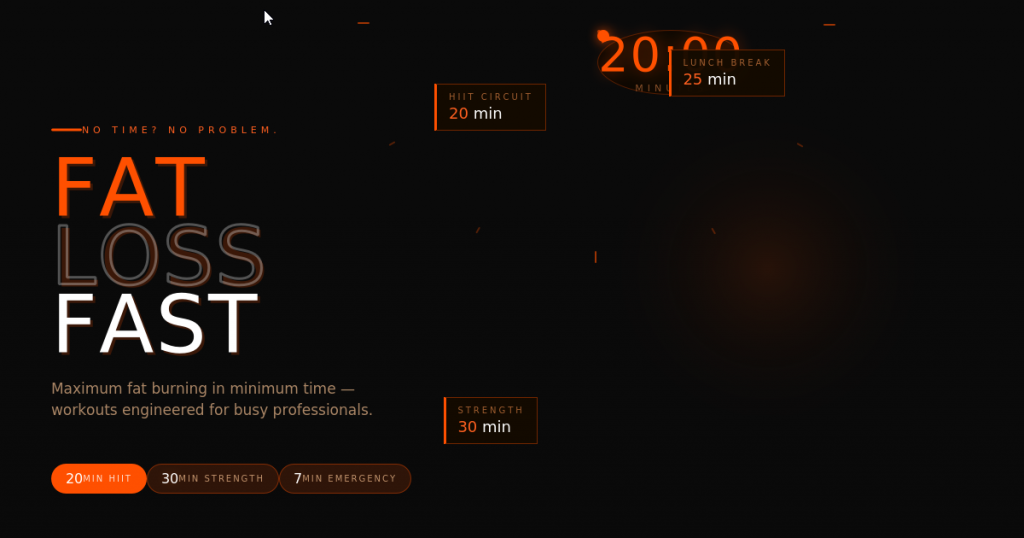

Time is the number one obstacle between most working adults and their fitness goals. Between demanding careers, family obligations, commutes, and the daily grind, the idea of spending 60–90 minutes in a gym several days a week is simply not realistic for most professionals. Yet the fitness industry continues to market programs built for people with unlimited time.
Here’s what the science actually shows: for fat loss specifically, shorter, intelligently designed workouts can be just as effective — and in some cases more effective — than long, low-intensity gym sessions. The key is maximizing exercise efficiency and ensuring that every minute of your training creates a meaningful fat-burning stimulus.
This guide presents the best fat loss workout strategies and complete programs for busy professionals, all designed to deliver real, measurable results in 20–40 minutes per session.
The Science of Time-Efficient Fat Loss Training
Traditional fitness wisdom suggests that longer workouts burn more calories and therefore produce more fat loss. While this is technically true in a given session, it misses a crucial insight from exercise science: what matters for long-term fat loss is not just calories burned during exercise, but the total 24–48 hour metabolic impact of your training.
Several training methods produce a disproportionately large metabolic impact relative to their duration:
- High-Intensity Interval Training (HIIT): Alternating between maximum effort and active recovery. Burns 25–30% more calories than steady-state cardio in the same timeframe and creates significant post-exercise oxygen consumption (EPOC — the “afterburn effect”).
- Heavy compound resistance training: Exercises like squats, deadlifts, and presses recruit large amounts of muscle tissue, creating a substantial metabolic stimulus and EPOC effect lasting 24–48 hours post-workout.
- Circuit training: Moving between exercises with minimal rest combines resistance and cardiovascular training, maximizing calorie burn and muscle retention simultaneously.
- Superset training: Pairing two exercises performed back-to-back with no rest between them. Reduces workout time by 30–40% without reducing total training volume.
Research published in the Journal of Strength and Conditioning Research demonstrated that 15–20 minutes of HIIT produced greater fat loss over 12 weeks than 30–40 minutes of moderate-intensity steady-state cardio in time-matched groups. The efficiency advantage of high-intensity training is not marginal — it’s dramatic.
The Non-Negotiable Principles for Busy Professional Workouts
Before diving into the workout programs, understand these principles that make short workouts effective for fat loss:
- Intensity over duration: A focused 20-minute workout at high intensity burns more fat in the subsequent 24 hours than a leisurely 45-minute gym visit. Push yourself — the workout being short is only acceptable if it’s actually hard.
- Compound movements dominate: Isolation exercises (bicep curls, leg extensions) are inefficient for fat loss. Compound multi-joint movements (squats, deadlifts, push-ups, rows, lunges) engage large muscle groups simultaneously, burning more calories and creating greater hormonal response.
- Minimize rest, maximize work: For fat loss, keep rest periods to 30–60 seconds between circuits. You should be breathing hard. If you can comfortably chat between sets, you’re not working hard enough.
- Consistency beats perfection: A 20-minute workout 4 days per week beats a 90-minute “perfect” workout you do once in a while. Build a realistic schedule and protect those time blocks.
- Strength training preserves muscle: This is critical during fat loss. Without resistance training, a significant portion of weight lost comes from muscle — reducing metabolic rate and undermining long-term results. Even 2 strength sessions per week maintains muscle during a fat loss phase.
The Weekly Workout Framework for Busy Professionals
Here’s the optimal weekly training structure for maximum fat loss with minimum time investment:
- Monday: Strength circuit (30 minutes)
- Tuesday: Active rest — 20-minute walk or walking pad
- Wednesday: HIIT cardio (20 minutes)
- Thursday: Active rest — 20-minute walk or optional yoga
- Friday: Strength + cardio hybrid (30 minutes)
- Saturday: Optional — longer active walk, sport, or recreational activity
- Sunday: Full rest
Total dedicated workout time: 80 minutes per week. Total active time including rest days: approximately 120 minutes per week. This is genuinely achievable for nearly every professional regardless of schedule — it’s less than 2 hours spread across the entire week.
Workout 1: The 30-Minute Fat-Burning Strength Circuit
This workout uses a circuit format with compound movements and minimal rest to maximize calorie burn and muscle retention simultaneously. Requires only dumbbells or a kettlebell — can be done at home or in a hotel gym.
Equipment needed: A pair of dumbbells (or adjustable dumbbells) and a mat.
Format: Complete all exercises in the circuit with 30 seconds rest between exercises. Rest 90 seconds between circuits. Complete 3 rounds.
Total time: approximately 28–32 minutes
Circuit (10 exercises × 3 rounds):
- Dumbbell Goblet Squat: 12 reps — Hold one dumbbell at chest height, squat deep with chest tall
- Dumbbell Romanian Deadlift: 12 reps — Hinge at hips, feel hamstring stretch, drive hips forward
- Dumbbell Push Press: 10 reps — Slight knee bend, explosive press overhead
- Dumbbell Bent-Over Row: 12 reps per side — Keep back flat, pull elbow to hip
- Reverse Lunges: 10 reps per leg — Step back, lower knee close to floor
- Dumbbell Chest Press (on floor): 12 reps — Arms to 90 degrees, press explosively
- Plank with Alternating Row: 10 reps per side — In plank position, row one dumbbell at a time
- Lateral Raises: 12 reps — Controlled up, slow down
- Dumbbell Swings (Kettlebell-style): 15 reps — Hip hinge and drive, swing to shoulder height
- Mountain Climbers: 30 seconds — Alternating knee drives, fast pace
Rest 90 seconds, then repeat the circuit 2 more times.
Workout 2: The 20-Minute HIIT Protocol
HIIT (High-Intensity Interval Training) is the most time-efficient cardio option for fat loss. This 20-minute workout burns 250–400 calories during the session and elevates metabolism for up to 24 hours after — a significant caloric advantage over the same duration of jogging.
Equipment needed: No equipment — bodyweight only.
Format: 40 seconds work, 20 seconds rest. 4 exercises per round, 4 rounds.
Total time: 20 minutes exactly
Warm-up (3 minutes before starting): Arm circles, leg swings, high knees × 30 seconds, jumping jacks × 30 seconds
Round 1–4 (same exercises, rotating):
- Jump Squats: 40 seconds — Squat down, explode up, land softly. If knees are an issue, use fast bodyweight squats instead.
- Push-Up to T-Rotation: 40 seconds — One push-up, rotate body to side plank (T-shape), alternate sides
- Alternating Reverse Lunge + Knee Drive: 40 seconds — Step back into lunge, drive same knee to chest explosively on the way up
- Burpees (or modified burpees): 40 seconds — Full burpee: squat, jump back to plank, push-up, jump forward, jump up. Modified: walk back and forward instead of jumping.
Rest 60 seconds between rounds.
Intensity check: By the end of round 2, you should be breathing hard enough that holding a conversation is difficult. If this isn’t the case, move faster or choose harder exercise modifications.
Workout 3: The 25-Minute Lunch Break Workout
Designed specifically to fit within a lunch break, this workout requires no shower (intensity is moderate) and can be done in a private office, conference room, or hotel room with zero equipment.
Equipment needed: None.
Format: Moderate intensity, continuous movement. Complete all exercises as one continuous circuit with 30 seconds transition time between exercises. 3 rounds total.
Total time: 25 minutes
The Circuit (8 exercises × 3 rounds):
- Bodyweight Squats: 20 reps
- Push-Ups (standard or modified): 15 reps
- Glute Bridges: 20 reps — Squeeze hard at the top, hold 1 second
- Tricep Dips (using a desk or sturdy chair): 12 reps
- Walking Lunges: 16 reps (8 per leg)
- Superman Hold: 10 reps (hold 2 seconds at top)
- Plank Hold: 40 seconds
- High Knees (moderate pace): 45 seconds

Workout 4: The 30-Minute Weekend Strength Session
This barbell/dumbbell workout is for weekend sessions when you have slightly more time and access to equipment. It focuses on the highest-impact compound lifts for maximum fat loss and muscle retention.
Equipment needed: Barbell + plates OR heavy dumbbells, pull-up bar.
Format: Superset pairs — complete both exercises back-to-back, then rest 90 seconds. 4 supersets × 3 rounds.
Total time: 30 minutes
Superset A:</strong>
<ul>
- A1: Barbell Squat — 5 reps (heavy)
- A2: Pull-Ups or Lat Pulldown — 8–10 reps
Superset B:</strong>
<ul>
- B1: Barbell Romanian Deadlift — 8 reps
- B2: Dumbbell Bench Press — 10 reps
Superset C:</strong>
<ul>
- C1: Dumbbell Overhead Press — 10 reps
- C2: Barbell or Dumbbell Row — 10 reps
Superset D:</strong>
<ul>
- D1: Reverse Lunges with Dumbbells — 10 per leg
- D2: Plank to Downward Dog — 12 reps
The 7-Minute Emergency Protocol
For those days when everything falls apart and you only have 7 minutes — this is better than nothing, and “better than nothing” compounds powerfully over months:
- 1 minute: Jump rope or jumping jacks
- 1 minute: Push-ups (as many as possible)
- 1 minute: Bodyweight squats (as fast as possible with good form)
- 1 minute: Mountain climbers
- 1 minute: Burpees
- 1 minute: Reverse lunges alternating
- 1 minute: Plank hold to failure
Seven focused minutes of all-out bodyweight training burns 60–100 calories and creates a hormonal response that influences metabolism for hours afterward.
Nutrition Strategies for Busy Professionals
For most professionals, diet is where fat loss is won or lost — not the gym. Short workouts cannot compensate for a consistently poor diet. These strategies are specifically designed for time-constrained professionals:
High-Protein Meal Prep (2 Hours on Sunday)
Spending 2 hours meal prepping on Sunday eliminates the decision fatigue and convenience eating that derails most diets during busy weeks. Prep in batch:
- 2–3 lbs of grilled chicken breast or baked salmon
- A large batch of roasted vegetables
- A large pot of quinoa or brown rice
- Hard-boiled eggs (6–8)
- Pre-portioned trail mix, Greek yogurt, and fruit for snacks
The 3-Ingredient Rule for Quick Meals
When you don’t have time for elaborate cooking: protein + vegetable + healthy fat. Examples: canned tuna + avocado + cucumber; cottage cheese + cherry tomatoes + olive oil drizzle; rotisserie chicken + baby spinach + olive oil lemon dressing. These meals take under 5 minutes to assemble and support fat loss consistently.
Strategic Intermittent Fasting
A 14:10 or 16:8 eating window (eating only within a 10–8 hour daily window) reduces caloric intake naturally without requiring calorie counting. Many professionals find skipping breakfast and eating their first meal at noon aligns naturally with their schedule — this creates a 14–16 hour overnight fast that promotes fat oxidation and simplifies meal planning.
Protein-First Eating
At every meal, eat your protein source first. This simple habit has been shown in research to reduce total meal calories by 10–15% by activating satiety signals earlier in the meal.
Maximizing Fat Loss Without More Gym Time
Remember that formal workouts represent only a fraction of your total daily caloric expenditure. These strategies increase fat loss without adding to your workout schedule:
- Walk during calls: Every phone or audio call becomes a walking opportunity. 60 minutes of call-walking per day adds 4,000–6,000 steps and 250–400 calories.
- Deskercise: Calf raises, seated core engagement, shoulder rolls, and standing hip stretches done throughout the workday maintain circulation and burn a small but cumulative number of calories.
- Stairs always: A non-negotiable policy of taking stairs burns 4–8 calories per flight and meaningfully elevates heart rate throughout the day.
- Commute optimization: If possible, bike or walk part of your commute. Even parking 15 minutes from the office adds 30 minutes of daily walking.
- Evening walks: A 20-minute walk after dinner improves blood glucose regulation, reduces evening snacking urge, and burns 100–150 additional calories.
Building the Habit: Making It Stick
The most effective workout program is the one you actually do consistently. For busy professionals, these strategies dramatically improve workout adherence:
- Time-block your workouts in your calendar as recurring appointments with the same importance as client meetings
- Lay out gym clothes the night before or sleep in them if you train first thing in the morning — removing any friction from the preparation process
- Keep a gym bag in your car or at the office so you’re always prepared for impromptu workout windows
- Use commute time for micro-preparation: Listen to energizing music or podcasts during your commute to arrive mentally primed for your workout
- Track your workouts publicly — even just texting a friend after each completed session creates accountability that dramatically improves consistency
- Set a minimum commitment: On days when motivation is zero, commit to just 10 minutes. You will almost always continue past 10 minutes once you start
Final Thoughts
Being busy is not an excuse to sacrifice your health — it’s a constraint that requires smarter fitness choices. The workouts in this guide are specifically engineered to deliver the most fat loss stimulus per minute of training time, using methods that research consistently shows outperform longer, lower-intensity approaches.
Twenty to thirty focused minutes, three to four times per week, is genuinely sufficient to transform your body composition when combined with mindful eating and increased daily movement. Start with one of these programs this week. Put it in your calendar. And in 12 weeks, you’ll understand what time-efficient fitness truly means.
Your schedule is never going to magically free up. Make the decision to work with it — not against it.