
How Many Calories Should I Burn Per Day to Lose Weight?
Calories are the currency of weight loss. Burn more than you consume, and your body turns to stored fat for energy. But the question most people actually want answered is far more specific: exactly how many calories do you need to burn per day to lose weight at a rate that’s meaningful, sustainable, and safe?
The answer depends on a combination of factors including your current body weight, your metabolic rate, your activity level, and how fast you want to lose weight. This guide walks through all of it — with practical calculations you can apply to your own life starting today.
The Foundational Principle: The Caloric Deficit
Weight loss, at its most fundamental level, is governed by one principle: you must burn more calories than you consume. This creates a caloric deficit — a negative energy balance that forces your body to access stored energy (primarily body fat) to make up the difference.
One pound of body fat contains approximately 3,500 calories of stored energy. This means that to lose one pound of fat, you need to create a cumulative deficit of 3,500 calories. Spread over a week, that equates to a daily deficit of 500 calories to lose approximately one pound per week.
However, it’s important to understand that this is a simplified model. Real-world weight loss is influenced by metabolic adaptation, water retention fluctuations, hormonal changes, and the composition of weight lost (fat vs. muscle vs. water). The 3,500-calorie rule is a useful planning tool, not an exact formula.
Step 1: Calculate Your Basal Metabolic Rate (BMR)
Your Basal Metabolic Rate (BMR) is the number of calories your body burns at complete rest — essentially, the energy required to keep you alive (breathing, circulating blood, maintaining body temperature, cellular repair) if you did absolutely nothing for 24 hours.
The most widely used and validated formula for calculating BMR is the Mifflin-St Jeor Equation:
For men:
BMR = (10 × weight in kg) + (6.25 × height in cm) − (5 × age in years) + 5
For women:
BMR = (10 × weight in kg) + (6.25 × height in cm) − (5 × age in years) − 161
Example calculation for a 35-year-old man, 180 lbs (82 kg), 5’10” (178 cm):
BMR = (10 × 82) + (6.25 × 178) − (5 × 35) + 5
BMR = 820 + 1,112.5 − 175 + 5
BMR = 1,762.5 calories per day
This is the baseline — the minimum calories your body burns without any physical activity whatsoever.
Step 2: Calculate Your Total Daily Energy Expenditure (TDEE)
Your Total Daily Energy Expenditure (TDEE) is the total number of calories you burn across an entire day when you factor in all physical activity, not just resting metabolism. TDEE is calculated by multiplying your BMR by an activity multiplier:
- Sedentary (desk job, little or no exercise): BMR × 1.2
- Lightly active (light exercise 1–3 days per week): BMR × 1.375
- Moderately active (moderate exercise 3–5 days per week): BMR × 1.55
- Very active (hard exercise 6–7 days per week): BMR × 1.725
- Extra active (very hard exercise, physical job, or twice-daily training): BMR × 1.9
Using our example: a moderately active man with a BMR of 1,762 calories:
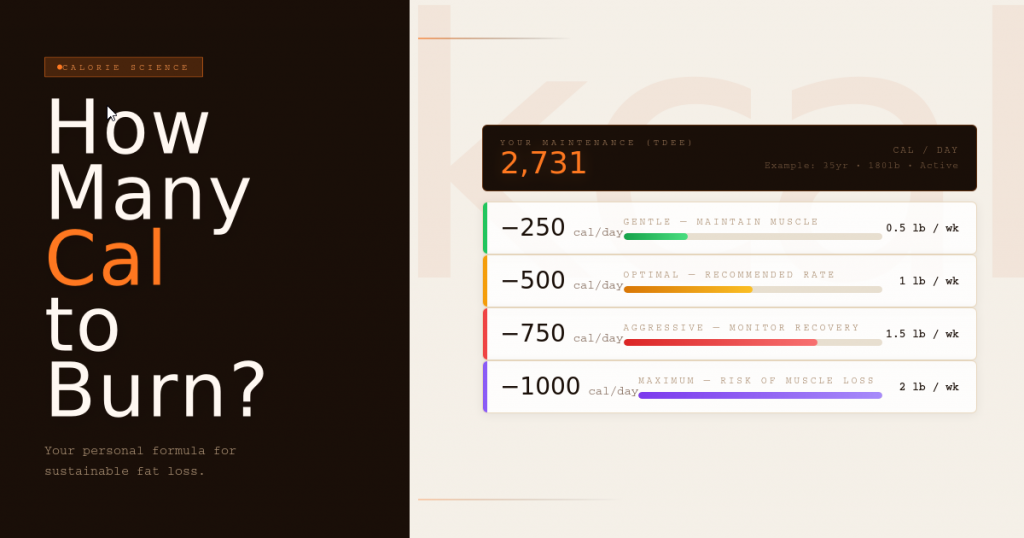
TDEE = 1,762 × 1.55 = 2,731 calories per day
This is his maintenance calorie level — the number of calories he needs to consume daily to maintain his current weight. To lose weight, he needs to either consume fewer calories, burn more through exercise, or both.
Step 3: Determine How Fast You Want to Lose Weight
How aggressive your caloric deficit should be depends on your weight loss goal. Here are the standard deficit targets:
- 0.5 lb per week: 250-calorie daily deficit
- 1 lb per week: 500-calorie daily deficit (the most commonly recommended rate)
- 1.5 lbs per week: 750-calorie daily deficit
- 2 lbs per week: 1,000-calorie daily deficit (generally the maximum recommended)
Why Faster Is Not Always Better
A 1,000-calorie daily deficit sounds tempting — twice the weight loss in the same time. But deficits larger than 500–750 calories per day create several serious problems:
- Muscle loss: In large deficits, the body breaks down muscle tissue for energy alongside fat. This reduces your resting metabolic rate, making ongoing weight loss progressively harder.
- Hormonal disruption: Extreme deficits suppress thyroid hormone production, reduce testosterone (in men), and disrupt leptin and ghrelin balance, leading to increased hunger and reduced metabolic rate.
- Nutrient deficiencies: Very low calorie intakes often fail to meet micronutrient requirements, leading to deficiencies in iron, calcium, B vitamins, and essential fatty acids.
- Rebound weight gain: Aggressive restriction is psychologically unsustainable. Most people who lose weight rapidly through severe restriction regain it — and often more — within 1–2 years.
For most people, a 500-calorie daily deficit producing 1 pound of fat loss per week is the ideal balance between meaningful progress and long-term sustainability.
How Many Calories Does Exercise Actually Burn?
Your caloric deficit can come entirely from reducing food intake, entirely from increasing exercise, or — most effectively — a combination of both. Here’s what various types of exercise actually burn:
Cardio Exercise (Per 30 Minutes, ~150 lb Person)
- Brisk walking (3.5 mph): approximately 150 calories
- Jogging (5 mph): approximately 240 calories
- Running (7 mph): approximately 350 calories
- Cycling (moderate effort): approximately 210 calories
- Swimming laps (moderate): approximately 210 calories
- Rowing machine (moderate): approximately 255 calories
- Jump rope: approximately 330 calories
- HIIT (high intensity intervals): approximately 300–380 calories
- Elliptical (moderate effort): approximately 190 calories
Strength Training (Per 45 Minutes, ~150 lb Person)
- Light weightlifting: approximately 130 calories
- Moderate strength training: approximately 200 calories
- Heavy compound lifting: approximately 250–300 calories
- Circuit training / supersets: approximately 280–350 calories
Important note: These are estimates. Actual calorie burn varies significantly based on body weight, fitness level, muscle mass, training intensity, and individual metabolic rate. Heavier individuals burn more calories doing the same activity.
The NEAT Factor: Your Secret Calorie-Burning Weapon
Most people obsess over workout calories and completely overlook the most variable and potentially impactful component of daily calorie burn: NEAT — Non-Exercise Activity Thermogenesis.
NEAT is the calories burned by all physical activity that isn’t formal exercise: walking to your car, fidgeting, doing laundry, standing at your desk, taking stairs, cooking, gesturing while talking. Research from the Mayo Clinic has shown that NEAT can vary by as much as 2,000 calories per day between individuals of similar size — making it potentially more impactful than any workout program.
People who naturally move more throughout the day — what researchers call “high NEAT individuals” — can have total daily energy expenditures dramatically higher than people who exercise the same amount but sit the rest of the day.
Strategies to Maximize NEAT
- Set a daily step goal of 8,000–10,000 steps and track it with a fitness tracker or smartphone
- Use a standing desk for at least part of your workday — standing burns roughly 50 more calories per hour than sitting
- Take walking breaks every hour — even 5 minutes of walking adds up to 40+ minutes per 8-hour workday
- Park farther from your destination and take stairs instead of elevators
- Walk during phone calls — this one habit alone can add thousands of steps daily
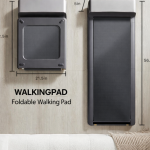
- Pace while watching TV or use a treadmill desk or walking pad
Calculating Your Personal Daily Calorie Burn Target
Here’s a step-by-step summary to calculate exactly how many calories you need to burn per day to hit your weight loss goal:
- Calculate your BMR using the Mifflin-St Jeor formula above
- Multiply by your activity factor to get your TDEE (maintenance calories)
- Determine your target weekly weight loss rate (0.5–2 lbs per week recommended)
- Multiply the weekly rate by 3,500 to get your required weekly caloric deficit
- Divide by 7 to get your daily caloric deficit target
- Subtract the daily deficit from your TDEE to get your target daily calorie intake
Example using our 35-year-old man (TDEE: 2,731 calories), targeting 1 lb/week loss:
- Required deficit: 500 calories/day
- Target daily intake: 2,731 − 500 = 2,231 calories per day
- He could also achieve this by eating 2,731 calories but burning 500 extra through exercise
- Or a combination: eat 250 fewer calories AND burn 250 extra through exercise
How Much Exercise Burns 500 Calories?
If you want to create your entire deficit through exercise rather than diet (or split the difference), here’s roughly how long various activities take to burn 500 calories for a 150–180 lb person:
- Running at 6 mph: approximately 40–50 minutes
- Brisk walking (3.5 mph): approximately 90–110 minutes
- Cycling (moderate-vigorous): approximately 60–75 minutes
- Swimming laps: approximately 60–75 minutes
- HIIT training: approximately 45–55 minutes
- Heavy weightlifting: approximately 80–100 minutes
- Rowing machine (vigorous): approximately 55–65 minutes
This illustrates why most experts recommend creating at least half of your deficit through dietary changes rather than exercise alone — burning 500 calories daily through exercise is time-intensive and difficult to sustain long-term.
Why You Might Be Burning Fewer Calories Than You Think
One of the most frustrating aspects of weight loss is discovering that popular calorie-tracking tools and gym equipment displays are often wildly inaccurate. A 2017 Stanford study found that common fitness trackers overestimated calorie burn by 27–93% depending on the device and activity type.
Several factors cause calorie burn overestimation:
- Metabolic adaptation: As you lose weight, your body becomes more efficient and burns fewer calories performing the same activities. A person who loses 20 lbs burns fewer calories on a 3-mile run than they did at their original weight.
- Fitness level: More fit individuals are more metabolically efficient — they burn fewer calories doing the same exercise than an unfit person.
- Compensatory behavior: Research shows that many people unconsciously eat more after exercise (“I earned it”) and move less during the rest of the day, partially offsetting calories burned during workouts.
- Device inaccuracy: As noted, most wearables significantly overestimate calorie burn.
How to Account for This
- Apply a 20–30% discount to calorie burn estimates from trackers and gym machines
- Track actual scale weight trends over 4+ weeks and adjust calorie intake based on real-world results
- Focus on creating your deficit through dietary control, using exercise as an additional (not primary) tool
The Role of Metabolic Adaptation in Long-Term Weight Loss
One of the most important — and least discussed — concepts in weight loss science is metabolic adaptation (also called adaptive thermogenesis). As you lose weight and stay in a prolonged caloric deficit, your body actively fights back by:
- Reducing thyroid hormone output, lowering resting metabolic rate
- Decreasing NEAT — you unconsciously move less throughout the day
- Increasing hunger hormones (ghrelin) and decreasing satiety hormones (leptin)
- Reducing the energy cost of physical activity
This is why weight loss slows over time even when you maintain the same diet and exercise regimen. To overcome metabolic adaptation:
- Include diet breaks: Every 8–12 weeks, return to maintenance calories for 1–2 weeks. This partially reverses metabolic adaptation and makes the next dieting phase more effective.
- Periodically recalculate your TDEE as your body weight decreases — your maintenance calories will be lower than they were when you started.
- Maintain strength training throughout your diet to preserve muscle mass and protect metabolic rate.
Putting It All Together: A Practical Daily Calorie Framework
Here’s the practical framework most people should follow for safe, effective, sustainable fat loss:
- Target a 500-calorie daily deficit for 1 lb/week fat loss — the gold standard for most people
- Create at least half the deficit through diet (250 calories) and the rest through exercise and NEAT (250 calories)
- Never eat below 1,200 calories/day (women) or 1,500 calories/day (men) — below these thresholds, it becomes nearly impossible to meet nutritional needs
- Track your intake accurately using a food scale and an app like MyFitnessPal or Cronometer for at least the first 4–6 weeks
- Weigh yourself daily and track the weekly average — day-to-day fluctuations from water, food volume, and hormones are misleading. Weekly averages reveal the true trend
- Adjust every 3–4 weeks based on actual progress, not expectations
Final Thoughts
The question “how many calories should I burn per day to lose weight?” has a clear, calculable answer — but applying it effectively requires understanding the broader context of metabolic rate, activity level, diet composition, and the physiological realities of weight loss.
The most sustainable approach is a moderate 500-calorie daily deficit, created through a combination of mindful eating and regular physical activity, with ongoing adjustments as your body weight and metabolism change over time.
Patience and consistency with this framework will produce steady, meaningful fat loss — without the metabolic damage, muscle loss, and rebound weight gain that come from chasing faster results through extreme restriction.