
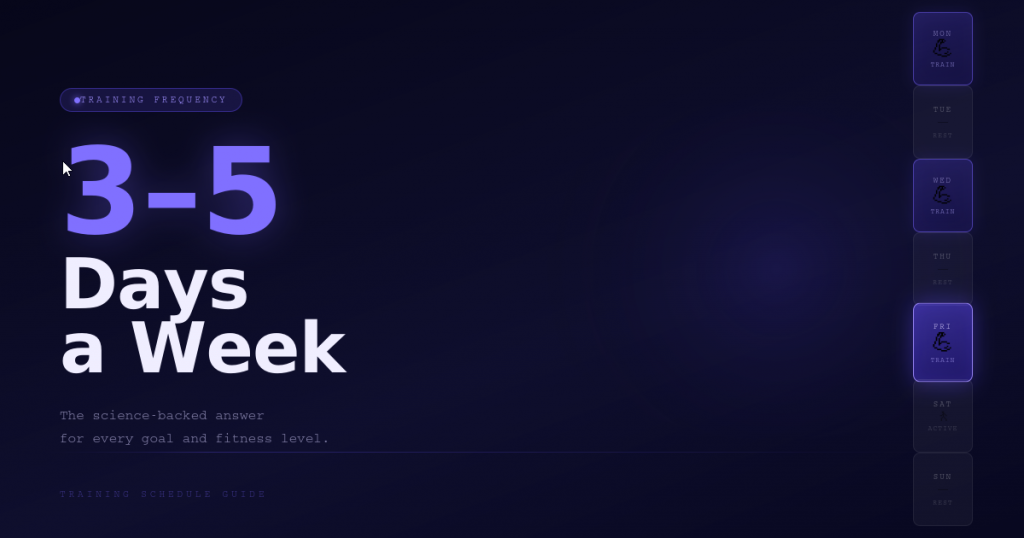

One of the most common questions in fitness — asked by complete beginners and seasoned athletes alike — is: how many days a week should I work out? The answer isn’t one-size-fits-all. It depends on your goals, fitness level, age, lifestyle, and the type of training you’re doing.
Get this number right and you’ll see consistent progress, stay injury-free, and actually enjoy your workouts. Get it wrong — too little or too much — and you’ll either stall your results or burn yourself out.
This comprehensive guide breaks down the science and practical guidance behind workout frequency so you can find the perfect training schedule for your life and your goals.

What the Research Actually Says
The American College of Sports Medicine (ACSM) recommends that healthy adults engage in moderate-intensity aerobic activity for at least 150 minutes per week, or vigorous-intensity activity for 75 minutes per week. For muscle-strengthening, they recommend training each major muscle group 2 or more days per week.
However, research also shows that frequency alone doesn’t determine results — total weekly training volume (the combination of sets, reps, and weight) is the primary driver of muscle and strength gains. You can achieve the same volume across 2, 4, or 6 days per week. What matters most is that the total workload is appropriate and that you allow adequate recovery.
The Key Variables That Determine Your Ideal Frequency
Before deciding how many days a week to train, consider these five critical variables:
- Your fitness goal: General health, weight loss, muscle building, athletic performance, and stress relief all call for different approaches.
- Your current fitness level: Beginners recover faster from low-volume sessions and need less frequency to make progress. Advanced athletes require more volume and more strategic programming.
- Your age: Recovery capacity decreases with age. A 22-year-old and a 50-year-old doing the same program need different recovery windows.
- Your training intensity: High-intensity workouts (heavy lifting, HIIT, sprinting) require more recovery than moderate-intensity cardio or light resistance training.
- Your lifestyle: Sleep quality, stress levels, physical job demands, and family obligations all affect how much training your body can handle and recover from.
Workout Frequency by Fitness Goal
Goal: General Health and Wellbeing
If your primary goal is to stay healthy, manage weight, reduce disease risk, and feel good, research clearly supports a minimum of 3–4 days per week of mixed exercise. This can include a combination of moderate cardio (brisk walking, cycling, swimming) and basic resistance training.
Recommended frequency: 3–4 days per week
Sample weekly schedule:
- Monday: 30-minute brisk walk
- Wednesday: 30-minute full-body bodyweight workout
- Friday: 30-minute walk or bike ride
- Sunday: Light yoga or stretching
Goal: Weight Loss and Fat Burning
Weight loss is primarily driven by a caloric deficit — burning more calories than you consume. Exercise supports this by increasing total daily energy expenditure. More training days typically means more calories burned, but only if recovery is adequate.
For fat loss, a combination of cardio and strength training is most effective. Strength training preserves muscle mass during a caloric deficit, which prevents the metabolic slowdown that derails many diet attempts.
Recommended frequency: 4–5 days per week
Sample weekly schedule:
- Monday: Strength training (full body)
- Tuesday: 30–45 minutes moderate cardio
- Wednesday: Rest or active recovery (walking)
- Thursday: Strength training (full body)
- Friday: 30–45 minutes moderate cardio or HIIT
- Saturday: Optional light activity
- Sunday: Rest
Goal: Building Muscle and Strength
Muscle hypertrophy (growth) requires progressive overload, sufficient protein intake, and adequate recovery between sessions. Research shows that training each muscle group 2 times per week is the sweet spot for most people — enough stimulus to grow without overtraining.
Recommended frequency: 3–5 days per week
Beginners (under 6 months of training) should stick to 3 full-body sessions per week. Intermediate and advanced lifters can benefit from 4–5 days using upper/lower or push/pull/legs splits, which allow each muscle group to be trained twice weekly.

Goal: Improving Cardiovascular Fitness
To meaningfully improve aerobic capacity (VO2 max, endurance, heart health), most experts recommend 4–5 cardio sessions per week ranging from 30 to 60 minutes. Varying intensity — mixing easy, moderate, and hard sessions — prevents adaptation and overuse injury.
Recommended frequency: 4–5 days per week
Goal: Athletic Performance and Sport-Specific Training
Competitive athletes often train 5–6 days per week, incorporating sport-specific skills, strength work, speed and agility drills, and active recovery. However, this level of frequency is typically supervised by coaches and is not appropriate for recreational exercisers or beginners.
Recommended frequency: 5–6 days per week (with professional guidance)
Workout Frequency by Experience Level
Complete Beginners (0–3 Months)
If you’re brand new to exercise, your number one priority is building the habit and learning movement patterns safely. Beginners see dramatic improvements from just 2–3 training days per week because the body is responding to exercise it hasn’t encountered before — this is called “newbie gains.”
Starting with too many days is one of the leading reasons beginners quit. Soreness, fatigue, and lack of recovery make the experience miserable. Start with 3 days, master the basics, and let consistency build the foundation.
Recommended frequency: 3 days per week
Intermediate Exercisers (3–12 Months)
After 3–6 months of consistent training, your body has adapted significantly and can handle more volume and frequency. Moving to 4 days per week allows for more training variety and a higher total weekly volume, which drives continued progress.
At this stage, consider transitioning from full-body workouts to an upper/lower split, which allows you to train each muscle group twice per week with more focused work per session.
Recommended frequency: 4 days per week
Advanced Exercisers (1+ Year of Consistent Training)
Experienced lifters and athletes often benefit from 5–6 training days per week using structured splits. At this level, greater specificity and volume are needed to stimulate further adaptation.
However, more days doesn’t always mean better results. Many advanced athletes find that 4 high-quality, high-intensity sessions produce better outcomes than 6 moderate sessions with accumulated fatigue. Quality always beats quantity.
Recommended frequency: 4–6 days per week
The Crucial Role of Rest Days
Rest days are not optional extras in your program — they are essential components of it. Here’s what actually happens on your rest days:
- Muscle repair: Microscopic tears created during resistance training are repaired, resulting in stronger, larger muscle fibers.
- Glycogen replenishment: Muscle fuel stores (glycogen) are fully restored, so you can train hard in your next session.
- Hormone regulation: Testosterone, growth hormone, and cortisol return to optimal levels.
- Nervous system recovery: Heavy compound lifting taxes the central nervous system (CNS). CNS fatigue impairs coordination, strength, and focus in subsequent workouts.
- Injury prevention: Overuse injuries are among the most common training injuries. Rest days dramatically reduce your risk.
Active Recovery vs. Full Rest
You don’t have to be completely sedentary on rest days. Active recovery — light movement that doesn’t tax your muscles or cardiovascular system — can actually accelerate recovery by increasing blood flow to muscles.
Good active recovery options include:
- A 20–30 minute leisurely walk
- Gentle yoga or stretching
- Light swimming
- Foam rolling and mobility work
Signs You’re Training Too Often (Overtraining)
More is not always better. Chronic overtraining can seriously derail your progress. Watch for these warning signs:
- Persistent soreness: Muscle soreness lasting more than 3–4 days after a session suggests insufficient recovery.
- Declining performance: If you’re consistently weaker, slower, or less enduring than in previous sessions, you may be overtrained.
- Sleep disturbances: Paradoxically, overtraining often causes insomnia despite physical exhaustion.
- Elevated resting heart rate: A resting heart rate 5–10 beats higher than your baseline is a classic overtraining signal.
- Mood changes: Irritability, anxiety, and low motivation are common symptoms of overreaching.
- Frequent illness: Overtraining suppresses immune function, leading to repeated colds and infections.
If you experience three or more of these symptoms, take 5–7 days of full rest, reassess your program, and reduce your weekly training frequency.
Signs You’re Not Training Enough (Undertraining)
The opposite problem is equally common. You might not be training enough if:
- You never feel physically challenged during or after workouts
- You’ve been doing the same routine for months without progression
- You don’t experience any muscle soreness when introducing new exercises
- Your body composition hasn’t changed despite weeks of effort
How to Build Your Weekly Workout Schedule
Here’s a practical step-by-step approach to designing your perfect training week:
- Identify your primary goal: Fat loss, muscle gain, general fitness, sport performance, etc.
- Assess your current fitness level: Be honest. Starting at beginner frequency ensures safe adaptation.
- Count your realistic available training days: Account for your actual schedule — work, family, travel. Consistent 3-day weeks beat sporadic 6-day weeks every time.
- Choose your training type split: Full body (great for beginners), upper/lower (intermediate), push/pull/legs (advanced).
- Schedule rest and recovery intentionally: Place rest days strategically between your most intense sessions.
- Monitor and adjust: Track how you feel week to week. Add a training day when you consistently feel recovered. Remove one when fatigue accumulates.
Sample Weekly Schedules at Every Level
3-Day Full Body (Beginner)
- Monday: Full body workout
- Tuesday: Rest or walk
- Wednesday: Full body workout
- Thursday: Rest or walk
- Friday: Full body workout
- Saturday–Sunday: Rest or active recovery
4-Day Upper/Lower Split (Intermediate)
- Monday: Upper body strength
- Tuesday: Lower body strength
- Wednesday: Rest or cardio
- Thursday: Upper body strength
- Friday: Lower body strength
- Saturday–Sunday: Rest or active recovery
5-Day Push/Pull/Legs (Advanced)
- Monday: Push (chest, shoulders, triceps)
- Tuesday: Pull (back, biceps)
- Wednesday: Legs
- Thursday: Rest or cardio
- Friday: Push
- Saturday: Pull or Legs
- Sunday: Rest
Final Thoughts
The best workout frequency is the one you can sustain consistently over months and years. Whether that’s 3 days or 5 days per week, what matters most is showing up, progressively challenging yourself, and recovering adequately between sessions.
Start with the minimum effective dose — 3 days per week — and only increase frequency when you’ve demonstrated consistent recovery and a desire for more challenge. The gym will always be there. Your job is to train smart enough to keep coming back.