

| ⚡ Key Takeaways Neither morning nor evening workouts are universally superior — consistency in your fitness routine is what drives results.Strength and power output tend to peak in the late afternoon (4–6 PM) due to body temperature rhythms.Morning workouts win for habit formation, fat oxidation in a fasted state, and mental clarity.The best time of day to exercise is the time you will actually show up — every single week.Your chronotype (natural sleep/wake rhythm) should heavily influence your choice. |
You’ve done the research. You’ve set the alarm. You’ve even laid out your gym clothes the night before. But every morning that alarm goes off, you think: “Is this even the right time to train? Should I just go after work?”
This mental loop is one of the most common momentum-killers for people starting their fitness journey. And it’s completely understandable. Social media is flooded with 5 AM warriors on one end and “science says evening is optimal” posts on the other. The result? Analysis paralysis before you’ve even started a workout.
In this article, we cut through the noise. We’ll examine what the research actually says, share nuanced “it depends” scenarios most beginner guides skip entirely, and help you land on the answer to the question: should I work out in the morning or evening? Spoiler: the science is more nuanced — and more liberating — than you think.
The “Why” Behind the Debate: Circadian Rhythms and Your Body Clock
Before we tell you what to do, you need to understand why this debate exists in the first place. It’s rooted in chronobiology — the science of how your body changes throughout the day.
Your body doesn’t operate on a flat line. Core body temperature, hormone levels (testosterone, cortisol, HGH), lung capacity, and even reaction time all follow a daily rhythm. Here’s what that means in plain terms:
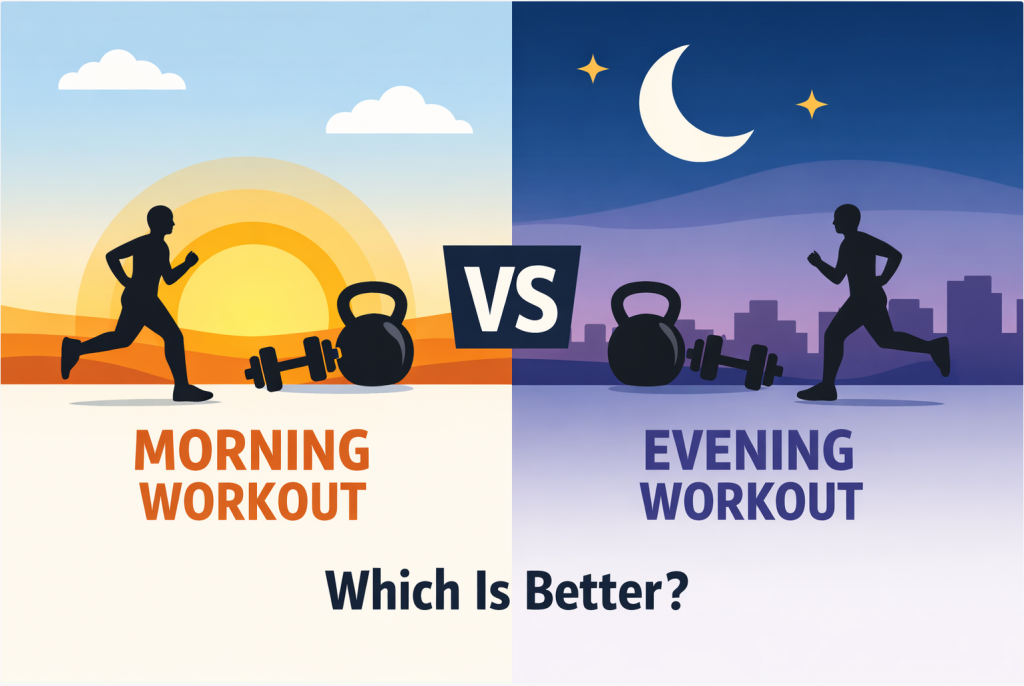
Morning Physiology (5 AM – 9 AM)
- Cortisol is naturally elevated — this is your body’s built-in wake-up call and can enhance alertness and fat mobilization.
- Core body temperature is lower, meaning muscles are stiffer and injury risk can be slightly higher without a thorough warm-up.
- Many people are in a fasted state, which may promote fat oxidation — particularly relevant for steady-state cardio.
Evening Physiology (4 PM – 8 PM)
- Core body temperature peaks — muscles are more pliable, reaction time is faster, and strength output is measurably higher (studies suggest 3–8% greater force production).
- Testosterone-to-cortisol ratio is more favorable for muscle building in late afternoon.
- Most people have already eaten, meaning energy stores (glycogen) are topped up for high-intensity work.
Here’s the contrarian insight most articles miss: these differences are real, but they’re marginal. For a beginner, the gap between a morning and evening workout in terms of physiological output is far less significant than the gap between working out consistently versus inconsistently.
Deep Dive: Morning vs. Evening — Scenario by Scenario
Scenario 1: You Want to Lose Body Fat
The case for mornings is strongest here. Fasted morning cardio (done before breakfast) has been shown in multiple studies to increase fat oxidation during the session. Your glycogen stores are partially depleted from overnight fasting, so your body turns to fat stores as fuel more readily.
Pro Tip: If you go this route, keep intensity moderate (Zone 2 cardio — conversational pace). High-intensity fasted training can lead to muscle breakdown and increased cortisol, which backfires for body composition.
Scenario 2: You Want to Build Muscle and Strength
Evenings have a measurable edge for resistance training. A 2022 study published in Frontiers in Physiology found that afternoon and evening training sessions led to greater hypertrophy (muscle growth) and strength gains over a 12-week period compared to morning sessions, in trained men.
However — and this is the nuance — the morning group still made significant gains. They simply needed a longer warm-up (15 minutes vs. 8 minutes) to match performance levels. If you’re a morning person who can commit to a thorough warm-up, the muscle-building potential is nearly identical.
Scenario 3: You Struggle With Consistency in Your Fitness Routine
Morning workouts win, hands down — not for physiological reasons, but for psychological ones. Here’s why:
- Decision fatigue is real. By evening, your willpower reserves are depleted. That “I’ll go after work” plan gets derailed by a tough meeting, a social invitation, or plain exhaustion.
- Morning workouts are protected time. Nothing gets scheduled at 6 AM without your permission.
- The “already won the day” effect is real — completing a workout before most people are awake provides a psychological momentum boost that research links to better mood, focus, and even dietary choices throughout the day.
Scenario 4: You’re a Night Owl (Chronotype Matters More Than You Think)
This is the “it depends” scenario almost every beginner article glosses over. Chronotype — your genetically influenced preference for sleep and wake times — significantly affects when you’ll perform best.
If you’re a genuine evening chronotype (a “night owl”), forcing 5 AM workouts isn’t heroic — it’s counterproductive. Sleep deprivation wrecks hormonal profiles, impairs recovery, and massively increases injury risk. A well-rested evening workout will outperform a sleep-deprived morning session every single time.
Pro Tip: Take the Munich Chronotype Questionnaire (MCTQ) — it’s free online and takes 5 minutes. Knowing your chronotype is one of the highest-leverage pieces of self-knowledge a fitness beginner can have.
Common Mistakes Beginners Make When Choosing Their Workout Time
Mistake #1: Choosing the “Optimal” Time Over the Sustainable Time
We see this constantly. Someone reads that the best time of day to exercise is 5 PM, sets an ambitious schedule, and misses three sessions in week one because life got in the way. A consistent 6 AM workout done five times a week will always outperform a “physiologically optimal” 5 PM session done twice.
Mistake #2: Skipping the Warm-Up for Morning Sessions
Morning muscle stiffness is real. Skipping straight into heavy lifts or intense cardio before your body temperature has risen is one of the leading causes of soft-tissue injuries in beginners. Spend at least 10–15 minutes on dynamic stretching and light movement — this is non-negotiable.
Mistake #3: Late-Night High-Intensity Training
Evening workouts are great — but not at 10 PM. High-intensity exercise elevates core temperature and adrenaline, which can delay sleep onset by 60–90 minutes. Poor sleep = poor recovery = poor results. If you’re an evening trainer, aim to finish by 8 PM, or shift to low-intensity yoga/mobility if training late.
Mistake #4: Switching Times Constantly
Consistency in your fitness routine includes time-of-day consistency. Your body adapts not just to the type of training but to when you train. Athletes who maintain a consistent training time demonstrate better performance adaptations over time than those who vary their schedule randomly. Pick a window and protect it.
The Future Outlook: Personalized Chronobiology and Wearable Tech
The morning vs. evening debate is evolving rapidly — and the answer is becoming far more personalized than any blanket recommendation can capture.
Wearables Are Changing the Game
Devices like WHOOP, Oura Ring, and the Apple Watch Ultra (with its advanced sleep staging) are now generating real-time HRV (Heart Rate Variability) data that can tell you, on any given day, whether your nervous system is recovered enough for intense training — regardless of the clock time. In 2026, the “best time” question is shifting from “when does biology say so?” to “when does my data say I’m ready?”
AI-Powered Adaptive Scheduling
Apps like Whoop Coach and emerging AI personal trainers are beginning to factor in your sleep quality, stress levels, and recovery metrics to recommend optimal training windows — not based on a population average, but on your data from last night. Within the next 3–5 years, the “morning vs. evening” debate will likely be replaced by AI-generated personalized training windows that shift week by week.
The Metabolic Timing Research Frontier
Emerging research in metabolic health is exploring how the timing of exercise interacts with meal timing (chronoNutrition) to influence blood sugar regulation, insulin sensitivity, and even longevity markers. For those with metabolic concerns (pre-diabetes, PCOS, obesity), exercising within 2 hours post-meal in the evening may offer benefits beyond what morning fasted training provides. This is an area worth watching closely.
Conclusion: Stop Optimizing, Start Showing Up
Here’s the truth we’ve found after reviewing the research and working with fitness beginners at every level: the best time of day to exercise is the time that fits your real life — the time you will defend, protect, and actually use, week after week.
If you’re a natural early riser who loves the quiet of the morning, lean into that. If you’re a night owl who performs best after 4 PM, stop fighting your biology. If your life is chaotic and you need to “lock in” your workout before the day hijacks your plans, set that alarm.
The one thing we know for certain: whether you’re asking “should I work out in the morning or evening?” or debating fasted cardio versus post-dinner lifts, none of it matters if you’re not showing up consistently. Consistency in your fitness routine is the only “hack” that actually works.
| ✅ Your Next Step This week, pick ONE consistent workout time — morning or evening — and commit to it for 21 days straight. Don’t change it. Don’t optimize it. Just show up. After three weeks, you’ll have the data you need (from your own body) to decide if it’s working. That’s more valuable than any study. |