

Music theory has a reputation problem. It’s treated like a prerequisite — something you suffer through so you can do the real thing. Most online resources don’t help. Dry text explanations. Static images of staff notation. Flash card apps that test whether you’ve memorized something you don’t yet understand.
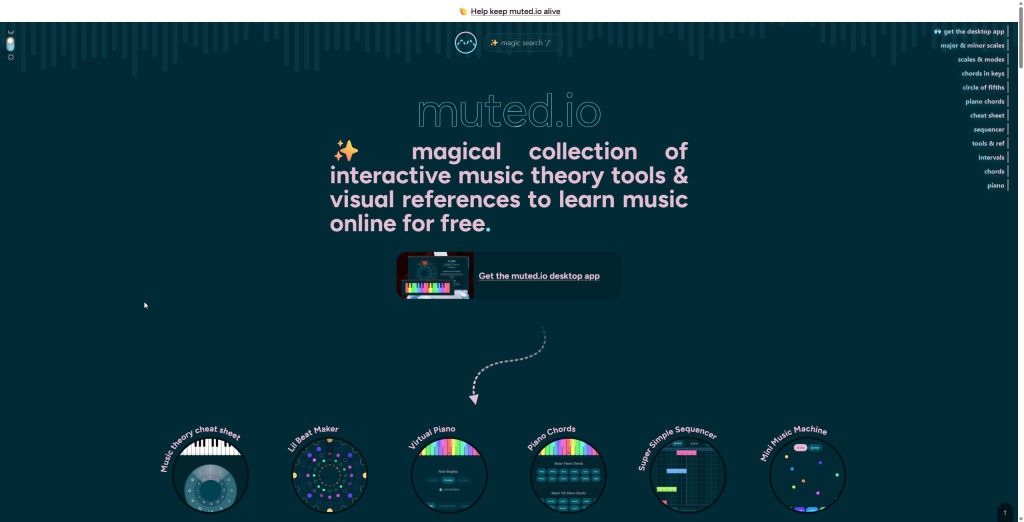
muted.io is built from a different starting point. It was created by a developer learning music theory as an adult who found existing tools frustrating and decided to build interactive, visual alternatives. The result is a free, browser-based collection of over 20 music tools that make theory tangible — something you click, play, and hear rather than read and memorize.
This review covers what the site actually contains, how well the tools work in practice, and who stands to get the most from it.
What’s Inside muted.io
The site is organized around its tools rather than a linear curriculum. There’s no “start here, go there” progression — you land on the homepage and navigate to whatever you need. The tools span piano, guitar, ukulele, and general theory, and can be broadly grouped as follows:
Piano Tools
The virtual piano is the most-visited tool on the site for good reason. It’s not a novelty toy — it’s a functional learning instrument. You can select any scale and highlight only the notes in that scale across the keyboard. You can lock those keys so only in-scale notes play, which is useful for improvisation practice. The piano chord tool lets you select a root note and chord type (major, minor, dominant 7th, diminished, etc.) and shows you the exact voicing on the keyboard.
There are also dedicated scale reference pages and interval training tools. The interval tool — where you hear two notes and identify the interval between them — is one of the more useful ear training exercises available for free anywhere on the web.
Guitar and Fretboard Tools
The virtual fretboard mirrors what the piano tools do but for guitar players: scale highlighting, chord voicing display, and an interactive reference for seeing where notes live across the neck. Bass and ukulele fretboards are also available. For players who learn by seeing patterns on the instrument rather than reading notation, these are genuinely useful practice companions.
The guitar tuner uses your device microphone and works accurately enough for casual use, though it doesn’t replace a dedicated hardware or dedicated tuner app for live performance.
Theory Reference Tools
The circle of fifths on muted.io is interactive — you can click a key and it highlights related keys, relative minors, and chord relationships. This is the clearest visual representation of key relationships available for free online. The music theory cheat sheet consolidates common reference information in a single printable or bookmarkable page. The chord progression builder helps you construct progressions within a key and hear them.
Beat Makers and Sequencers
The site also includes a step sequencer, a simple beat maker, and a melody machine — browser-based composition tools that let you produce simple musical ideas without installing a DAW. These are clearly aimed at beginners and experimenters; they’re not production tools. But for someone who wants to hear how a chord progression sounds in context, or experiment with rhythm patterns, they serve a practical purpose.
Who muted.io Is Actually Built For
- Adult beginners learning an instrument who want theory to make sense, not just be memorized
- Self-taught guitarists or pianists who skipped formal theory and now want to fill the gaps
- Music producers working in a DAW who want a quick reference for scales and chords while they work
- Songwriters who know what sounds good but want to understand why — and expand from there
- Ukulele and bass players who can’t find instrument-specific theory resources elsewhere
- Students supplementing formal lessons with visual, interactive practice outside of class
- Anyone who tried music theory from a textbook and bounced off the static diagrams
- Casual musicians who want to experiment with sound in a browser without installing anything
Honest Assessment
✅ What muted.io Gets Right
- Completely free and — unusually — ad-free: this is genuinely rare for a tool site of this quality and breadth
- No login required: you open the site, you use the tools, nothing more
- The visual approach to theory (highlighting scales on a keyboard, showing chord shapes on a fretboard) is more effective for most learners than text-based explanation
- Covers piano and guitar with equal depth — most theory sites favor one
- The circle of fifths tool is among the best free implementations available
- Clean, modern interface that works well on mobile — you can genuinely use it next to your instrument
- The browser-based beat maker and sequencer add a compositional dimension that pure reference tools lack
❌ Where the Limits Show
- It’s a reference and tool collection, not a course — there’s no structured learning path, no feedback on progress, no curriculum
- Advanced theory topics are thin: figured bass, voice leading, counterpoint, and orchestration aren’t covered
- The beat maker and sequencer are entry-level — musicians wanting to actually produce music will outgrow them quickly
- No MIDI integration in the browser tools — you can’t connect a keyboard and play through the virtual piano with your instrument
- The tuner is adequate but not reliable enough for precise pitch work or live performance
- Content depth assumes some existing music context — complete beginners may need introductory guidance before some tools make sense
How muted.io Compares to Similar Resources
vs. musictheory.net
musictheory.net is an older but well-regarded site that offers structured lessons alongside its reference tools. It has a more traditional, curriculum-style approach: lesson one, lesson two, exercises, quizzes. If you want a guided path through the fundamentals of music theory — especially if you’re learning to read notation — musictheory.net is more structured. muted.io wins on visual interactivity, instrument-specific tooling, and the quality of its chord and scale visualizations. The two sites are genuinely complementary: musictheory.net for structured learning, muted.io for visual reference during practice. Bottom line: They solve different problems — use musictheory.net if you want lessons, muted.io if you want tools to use while playing.
vs. Hooktheory
Hooktheory specializes in chord progressions and harmonic analysis, with a database of popular songs analyzed by their chord functions. It’s excellent for songwriters who want to understand what makes hit songs work and how to construct similar progressions. But Hooktheory gates most of its content behind a paid subscription, and its instrument-specific tools are limited. muted.io’s free chord tools aren’t as analytically deep, but they’re available immediately without a subscription. For learning theory through your instrument in real time, muted.io is the more accessible option. Bottom line: Hooktheory for deep harmonic analysis of songs; muted.io for interactive instrument-based theory practice, free.
Pricing and the Desktop App
- Browser tools: Fully free, no account, no ads
- muted.io desktop app (Mac, Windows, Linux): Paid — gives you access to 23 tools as always-on-top floating windows, designed for use alongside a DAW or practice session
- Desktop app guarantee: 30-day money-back, no questions asked
- Chordwatch desktop app: Separate paid tool — detects chords played on a MIDI keyboard and displays names, inversions, and intervals in real time
The free browser version gives you everything most learners need. The paid desktop app is aimed at working musicians who want always-on-top reference windows during a session without switching browser tabs. It’s a sensible upsell, not a paywall on the core tools. Explore the free tools first: visit muted.io →
Should You Use It?
Yes, if you:
- Play piano, guitar, bass, or ukulele and want visual scale and chord references while practicing
- Are self-taught and have gaps in theory you want to fill without signing up for a course
- Produce music in a DAW and need quick key/scale/chord reference without breaking workflow
- Find traditional theory resources too abstract or notation-heavy
- Want free tools with zero account friction and no advertising interruptions
- Are curious about the circle of fifths and want an interactive version you can actually play with
- Are a music teacher looking for shareable visual aids for students
Look elsewhere if you:
- Need a structured course with lessons, exercises, and measurable progress
- Are studying advanced theory topics like counterpoint, orchestration, or analysis of extended harmony
- Want MIDI integration so you can play a connected keyboard through the browser tools
- Need a production-ready DAW or beat maker — these tools are introductory
- Are preparing for formal music theory exams (ABRSM, RCM, AP Music Theory) — you’ll need structured curriculum support
Final Verdict
muted.io fills a real gap. Most music theory resources on the internet are either too abstract, too text-heavy, or paywalled behind subscriptions that assume you’re already committed to serious study. muted.io is none of those things. It’s free, it’s immediate, it’s visual, and it’s built for the way people actually learn instruments — by doing, not by reading.
The absence of a structured curriculum is a genuine limitation for complete beginners who need someone to tell them what to learn and in what order. But for anyone past that initial stage — people who have been playing for a while and want to understand what they’ve been doing intuitively — muted.io is the right bookmark to have open during a practice session.
In a web where most “free” music tools are either low quality, ad-stuffed, or gated behind eventual paywalls, muted.io is an honest exception. It’s free, it works, and it was built by someone who actually needed it.
Rating: 4 / 5 stars — A standout free music theory resource that rewards hands-on learners. Not a replacement for structured lessons, but an excellent companion to them. Try the free tools at muted.io →
Disclosure: This review contains affiliate links. We may earn a commission if you click through and purchase. Our assessments are editorially independent and reflect genuine use of the platform.