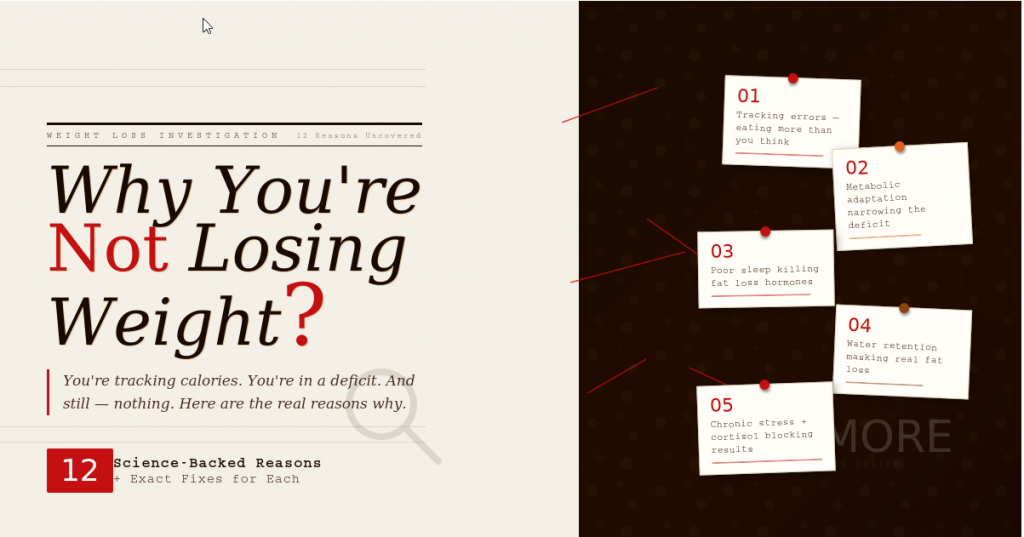

You’re tracking your food. You’re watching your portions. Your fitness app says you’re in a 500-calorie deficit every day. And yet — the scale isn’t moving. Or worse, it’s going up.
This is one of the most frustrating and demoralizing experiences in fitness. You’re doing everything right according to the conventional wisdom, and it’s not working. Before you conclude that your metabolism is broken, that you’re the exception to the laws of thermodynamics, or that you’re destined to carry this weight forever — understand this: there are well-documented, fixable reasons why people in an apparent calorie deficit fail to lose weight.
This guide covers all of them — from the most common tracking errors to the genuine physiological factors that can impede weight loss — with specific, actionable solutions for each.
First: Understanding the Real Energy Balance
The foundational principle of weight loss — calories in must be less than calories out — is physiologically correct and universally applicable. No human being is immune to thermodynamics. However, both sides of this equation are far more complex and variable than most people realize, which is exactly why “eating less and moving more” often fails to produce expected results in practice.
The calories-in side is consistently underestimated by most people. The calories-out side is consistently overestimated. And several physiological mechanisms actively work to narrow the gap between the two as you diet. Understanding these dynamics is the key to finally breaking through your plateau.
Reason 1: You’re Consuming More Calories Than You Think
This is, by a significant margin, the most common reason people don’t lose weight in a perceived caloric deficit. Research is both consistent and humbling on this point: people systematically and significantly underestimate their caloric intake.
A landmark NIH study found that study participants underreported their food intake by an average of 47%. That means people who thought they were eating 1,500 calories were actually consuming approximately 2,200.
The Common Culprits of Calorie Underestimation
- Oil, butter, and cooking fats: A tablespoon of olive oil contains 120 calories. Drizzling oil into a pan “to taste” while cooking can easily add 300–600 calories to a meal without any deliberate decision to do so. Most people dramatically underestimate the amount of fat used in cooking.
- Sauces, dressings, and condiments: A “healthy” salad can become a 700-calorie meal through generous application of dressing. Two tablespoons of ranch dressing = 145 calories. A large restaurant-portioned salad dressing = 300–500 calories.
- Liquid calories: Coffees with cream and sugar, juice, sports drinks, alcohol, smoothies, and flavored waters all contain calories that people rarely factor into their daily totals. A caramel latte can easily contain 400+ calories.
- Portion size errors: Without weighing food, visual portion estimates are notoriously inaccurate. Most people underestimate portions by 20–40%. A “tablespoon” of peanut butter eyeballed can easily be 2–3 tablespoons (300+ calories instead of 100).
- Bites, licks, and tastes (BLTs): Unconscious eating while cooking, tasting children’s food, finishing leftovers off someone’s plate — these “invisible” calories add up to 200–400 calories per day for many people who believe they “didn’t eat much.”
- Restaurant and takeout underestimation: Restaurant portions are frequently 2–3× larger than labeled, and restaurant cooking uses far more fat than home cooking. A “healthy” restaurant meal can easily contain 700–1,200 calories more than the equivalent home-cooked version.
The Fix: Accurate Calorie Tracking for 2–4 Weeks
Use a food scale (not measuring cups) to weigh everything you eat for 2–4 weeks. Log every meal in a tracking app like MyFitnessPal, Cronometer, or Lose It. Be forensic about it — every bite, every ingredient, every condiment. Most people are genuinely shocked by what they discover. This exercise alone solves the deficit puzzle for a majority of people who believe they “can’t lose weight.”
Reason 2: Your Calorie Burn Estimates Are Wildly Inaccurate
The “calories out” side of the equation is just as error-prone as the calories-in side. Fitness trackers, gym equipment displays, and online calorie calculators routinely overestimate calorie burn by 20–93%.
- Fitness trackers: A Stanford University study found that popular wrist-worn fitness trackers overestimated calorie burn by an average of 27%, with the worst performers overestimating by up to 93%.
- Cardio machine displays: Treadmill and elliptical calorie counters typically overestimate by 20–40%, especially when using generic calculation algorithms without personal metabolic data.
- Exercise apps and calculators: TDEE calculators and exercise calorie estimators are based on population averages. Your individual metabolic rate may be 10–20% lower than the formula predicts.
The Fix
Apply a conservative 20–25% reduction to all calorie burn estimates from technology. Use actual scale weight trends over 4–6 weeks as your true measurement of whether your deficit is real. If the scale isn’t moving, your deficit isn’t as large as your tools suggest — regardless of what they say.
Reason 3: Metabolic Adaptation Has Narrowed Your Deficit
Metabolic adaptation (also called adaptive thermogenesis) is a genuine physiological phenomenon that makes sustained weight loss progressively harder. When you reduce caloric intake and lose weight, your body actively responds by reducing its energy expenditure through multiple mechanisms:
- Reduced resting metabolic rate: As you lose weight, you have less tissue to maintain, so you burn fewer calories at rest. A 200-pound person burns more calories sleeping than a 160-pound person.
- Reduced exercise efficiency cost: A lighter body burns fewer calories doing the same workout.
- Reduced NEAT: Research has documented that people unconsciously move less — fidgeting less, taking fewer spontaneous steps, making smaller movements — when in a prolonged caloric deficit. This can reduce non-exercise calorie burn by 200–400 calories per day.
- Hormonal changes: Leptin (satiety hormone) decreases, ghrelin (hunger hormone) increases, thyroid output reduces, and testosterone levels drop in men — all conspiring to increase appetite and decrease metabolic rate.
Research suggests that these adaptive mechanisms can reduce total daily energy expenditure by 250–500 calories beyond what would be predicted from weight loss alone, completely eliminating a deficit that once existed.
The Fix
- Recalculate your TDEE every 4–6 weeks based on your current weight, not your starting weight
- Take planned diet breaks — 1–2 weeks of eating at maintenance calories every 8–12 weeks partially reverses metabolic adaptation
- Increase protein intake — a high-protein diet partially protects against metabolic rate reduction during a deficit
- Prioritize resistance training to maintain muscle mass, which is the primary determinant of resting metabolic rate
- Consciously increase NEAT by tracking daily steps and setting a minimum target of 8,000–10,000 steps
Reason 4: Water Retention Is Masking Fat Loss
One of the most common reasons the scale doesn’t reflect actual fat loss is water retention. Your body can retain — or release — 2–5 pounds of water in a single day based on factors entirely unrelated to fat loss:
- High sodium intake: Sodium causes water retention. A high-salt meal can add 2–4 lbs of water weight within 24 hours.
- Carbohydrate intake: Each gram of glycogen stored in muscle is bound to approximately 3–4 grams of water. Increasing carbohydrate intake after a low-carb period can add 2–5 lbs of glycogen-bound water almost overnight.
- Inflammation from exercise: Starting a new workout program or significantly increasing exercise volume causes temporary muscle inflammation and associated water retention. This is particularly pronounced in the first 2–4 weeks of a new training program.
- Hormonal fluctuations: In women, estrogen and progesterone levels throughout the menstrual cycle cause significant water retention — up to 5 lbs — particularly in the week before menstruation. This can completely mask real fat loss on the scale.
- Stress and cortisol: Chronically elevated cortisol promotes water retention, particularly in the abdominal region.
- Sleep deprivation: Poor sleep elevates cortisol and aldosterone, both of which promote fluid retention.
The Fix
Never judge weight loss progress by a single day’s scale reading. Weigh yourself at the same time each morning (after using the bathroom, before eating or drinking) and track your weekly average weight rather than day-to-day fluctuations. A downward trend in weekly averages indicates real fat loss, regardless of day-to-day volatility.
Reason 5: You’re Building Muscle While Losing Fat
This is the rare scenario that is actually great news: if you’re new to strength training or returning after a long break, you may be simultaneously gaining muscle mass and losing fat — with the scale barely moving as a result. Muscle is denser than fat, so if you gain 2 lbs of muscle while losing 2 lbs of fat, the scale shows zero change despite a dramatically improved body composition.
The Fix
Monitor progress through body composition measurements rather than scale weight. Progress photos every 4 weeks, body measurements (waist, arms, thighs), and improving strength performance in the gym are all signs of successful body recomposition — even when the scale is stubborn.
Reason 6: You’re Not Sleeping Enough
Sleep deprivation is one of the most powerful and underappreciated obstacles to fat loss. Research from the University of Chicago found that dieters who slept 5.5 hours per night lost 55% less fat than those who slept 8.5 hours — despite eating the same calorie-restricted diet. Inadequate sleep impairs fat loss through multiple mechanisms:
- Increased ghrelin: Sleep deprivation raises the hunger hormone ghrelin by 15–20%, creating intense appetite and cravings for high-calorie foods
- Decreased leptin: The satiety hormone drops significantly, meaning you feel less full from the same food
- Elevated cortisol: Promotes fat storage (especially visceral belly fat) and muscle breakdown
- Impaired glucose metabolism: Poor sleep reduces insulin sensitivity, promoting fat storage over fat burning
- Reduced willpower and decision-making: Sleep deprivation impairs the prefrontal cortex — the brain region responsible for impulse control and delayed gratification — leading to more frequent dietary lapses
The Fix
Treat sleep as a non-negotiable component of your fat loss program. Prioritize 7–9 hours per night. Establish a consistent sleep schedule, limit blue light exposure 1–2 hours before bed, keep your bedroom cool (65–68°F is optimal for sleep quality), and avoid caffeine after 2 PM.

Reason 7: Chronic Stress Is Elevating Cortisol
Chronic psychological stress — a near-universal feature of modern life — elevates cortisol levels around the clock. This matters for fat loss because cortisol:
- Signals the body to store energy as fat — particularly visceral (abdominal) fat, which is stubborn and metabolically harmful
- Breaks down muscle tissue (catabolism) for glucose, reducing metabolic rate
- Drives cravings for calorie-dense comfort foods through activation of the reward system
- Disrupts sleep, creating the cascade described above
- Causes water retention through activation of aldosterone
People under chronic stress can do everything nutritionally “right” and still struggle to lose fat due to the hormonal environment created by cortisol.
The Fix
- Implement a daily stress-management practice: meditation, journaling, deep breathing, or regular nature walks (even 20 minutes in a park significantly reduces cortisol)
- Reduce training intensity temporarily if overtraining is contributing to cortisol load
- Address lifestyle stressors where possible — workload, relationship conflict, financial anxiety — these have direct physiological consequences for fat loss
Reason 8: Alcohol Is More Damaging Than You Realize
Alcohol is uniquely damaging to fat loss progress for several reasons beyond its caloric content:
- Liquid calories rarely tracked: A glass of wine (150 calories), two cocktails (300–500 calories), or a few beers (450–600 calories) are consistently overlooked in calorie tracking
- Alcohol metabolism shuts down fat burning: When alcohol is present, it becomes the body’s priority fuel source. While metabolizing alcohol, fat burning essentially stops — a process that can last 6–12+ hours after drinking
- Poor food decisions: Alcohol impairs judgment and increases cravings for calorie-dense food, leading to nighttime eating that can add 500–1,500 calories in one sitting
- Sleep disruption: Even moderate alcohol consumption reduces REM sleep and sleep quality, with the consequences described above
- Hormonal disruption: Regular alcohol consumption reduces testosterone and growth hormone, impairs liver function, and increases cortisol
The Fix
Honestly account for all alcohol in your calorie tracking. Aim to limit consumption to 1–2 drinks maximum on 1–2 days per week, or eliminate it entirely during active fat loss phases. If alcohol is an important social or recreational component of your life, plan for it explicitly in your weekly calorie budget.
Reason 9: Gut Health and Microbiome Imbalances
Emerging research — while still evolving — suggests that the gut microbiome can meaningfully affect weight management. Studies have found that obese individuals have different gut bacteria profiles than lean individuals, and that certain bacterial compositions are associated with more efficient calorie extraction from food and increased fat storage.
Additionally, gastrointestinal inflammation from poor diet, antibiotic use, or chronic stress can impair nutrient absorption, promote systemic inflammation (which inhibits fat loss), and alter hunger hormone signaling.
The Fix
- Eat a diverse, high-fiber diet rich in vegetables, legumes, and whole grains to feed beneficial gut bacteria
- Include fermented foods: Greek yogurt, kefir, sauerkraut, kimchi, and miso support microbiome diversity
- Minimize ultra-processed food consumption, which disrupts gut bacterial populations
Reason 10: Medical Conditions and Medications
Several medical conditions and medications can genuinely impair weight loss even when caloric deficit is maintained:
- Hypothyroidism: An underactive thyroid reduces resting metabolic rate by 15–40% and makes weight loss significantly more difficult. Symptoms include fatigue, cold sensitivity, hair loss, and weight gain.
- Polycystic Ovary Syndrome (PCOS): Affects hormonal balance and insulin sensitivity, making fat loss resistant.
- Insulin resistance: Reduces the body’s ability to use carbohydrates for energy, promoting fat storage.
- Cushing’s syndrome: Characterized by chronically elevated cortisol, promoting fat storage especially in the abdominal area.
- Medications: Several common medications contribute to weight gain or impair loss, including some antidepressants (SSRIs, tricyclics), beta-blockers, corticosteroids, antipsychotics, and some diabetes medications.
The Fix
If you’ve been consistently in a genuine caloric deficit for 3+ months with no measurable weight loss, consult a physician and request thyroid function tests (TSH, T3, T4), fasting insulin and glucose, and a general hormonal panel. Addressing an underlying medical condition may be the key that unlocks your weight loss entirely.
Reason 11: Your Deficit Is Too Aggressive (Starvation Mode Is Partly Real)
Paradoxically, eating too little can impair fat loss. While the extreme version of “starvation mode” (the claim that eating very little causes weight gain) is a myth, the reality is more nuanced: very severe caloric restriction causes the body to:
- Aggressively reduce NEAT (unconscious movement), potentially eliminating 300–500 calories of daily expenditure
- Reduce thyroid hormone output by up to 40%, slowing metabolic rate
- Break down significant amounts of muscle tissue for energy, further reducing metabolic rate
- Dramatically increase hunger hormones, making deficit adherence nearly impossible
Someone eating 800–1,000 calories per day may have such severe metabolic adaptation that their total energy expenditure has dropped to 1,000–1,200 calories — eliminating the deficit entirely.
The Fix
Never go below 1,200 calories for women or 1,500 calories for men. A moderate deficit of 300–500 calories per day is more effective over the long term than aggressive restriction, because it preserves metabolic rate, maintains muscle, and is far more sustainable.
Reason 12: You Haven’t Given It Enough Time
Finally — and this one requires honesty — most people don’t give their fat loss program enough time before declaring it a failure. Real fat loss is slow:
- 1 lb of fat per week is the evidence-based maximum for most people without muscle loss
- Week-to-week scale fluctuations of 2–5 lbs from water are completely normal and unrelated to fat loss
- Visible body composition changes typically take 8–12 weeks before they’re clearly apparent
Many people abandon their program after 2–3 weeks when the scale “isn’t moving” — when they may actually be losing fat steadily but having it masked by water retention from a new exercise routine, dietary changes, or hormonal cycles.
The Fix
Commit to a minimum of 6–8 weeks before evaluating whether your program is working. Track weekly average weight, progress photos, and body measurements. Look for trends across 4+ weeks rather than reacting to daily fluctuations.
Action Plan: How to Break Through Your Plateau
If you’re not losing weight in a perceived caloric deficit, work through this checklist systematically:
- Audit your tracking: Use a food scale for every meal for 2 weeks. Log everything including cooking oils, sauces, and drinks.
- Recalculate your actual TDEE based on your current weight and honest activity level.
- Reduce your daily calorie target by 100–150 calories and observe results over the next 3–4 weeks.
- Evaluate sleep quality: Are you consistently getting 7–9 hours? Fix this before anything else if the answer is no.
- Track your daily steps and set a minimum target of 8,000 to ensure NEAT isn’t dropping.
- Honestly account for alcohol — even if it’s uncomfortable to acknowledge.
- Take progress photos and measurements to determine if body composition is improving even when the scale is stable.
- If all else fails, consult a physician to rule out medical conditions.
Final Thoughts
Not losing weight in a calorie deficit is almost never a mystery — it’s a solvable problem with identifiable causes. The most common culprits are calorie tracking errors, overestimated exercise calorie burn, metabolic adaptation, water retention, and lifestyle factors like sleep and stress that most people don’t connect to their weight.
Work through each potential cause systematically, make evidence-based adjustments, and give each change at least 3–4 weeks to produce measurable results. Patience, accuracy, and intellectual honesty about what’s actually going into your body are the three qualities that separate people who eventually succeed at fat loss from those who remain frustrated indefinitely.
The laws of thermodynamics haven’t made an exception for you — but they haven’t abandoned you either. Your body will respond when the conditions are truly right.