

Why Most Lifters Stop Making Progress
You train hard every week. You show up consistently. But the mirror hasn’t changed in months, and your lifts feel stuck. If that sounds familiar, the answer almost always comes back to one thing: progressive overload. Most people follow the same weights, the same reps, and the same sets — week after week — and then wonder why nothing changes.
Understanding what is progressive overload isn’t just for elite athletes. It is the foundational principle behind every effective training program ever written. Without it, your muscles have no reason to adapt. With it, even a simple gym routine becomes a reliable growth machine.
This article breaks down the actual science. You will learn how your muscles detect and respond to new stress, how metabolic stress in weightlifting drives hypertrophy, and how to choose between linear periodization vs. block periodization based on your goals and experience level. No fluff — just the mechanisms that matter.
What Is Progressive Overload? The Core Principle Explained
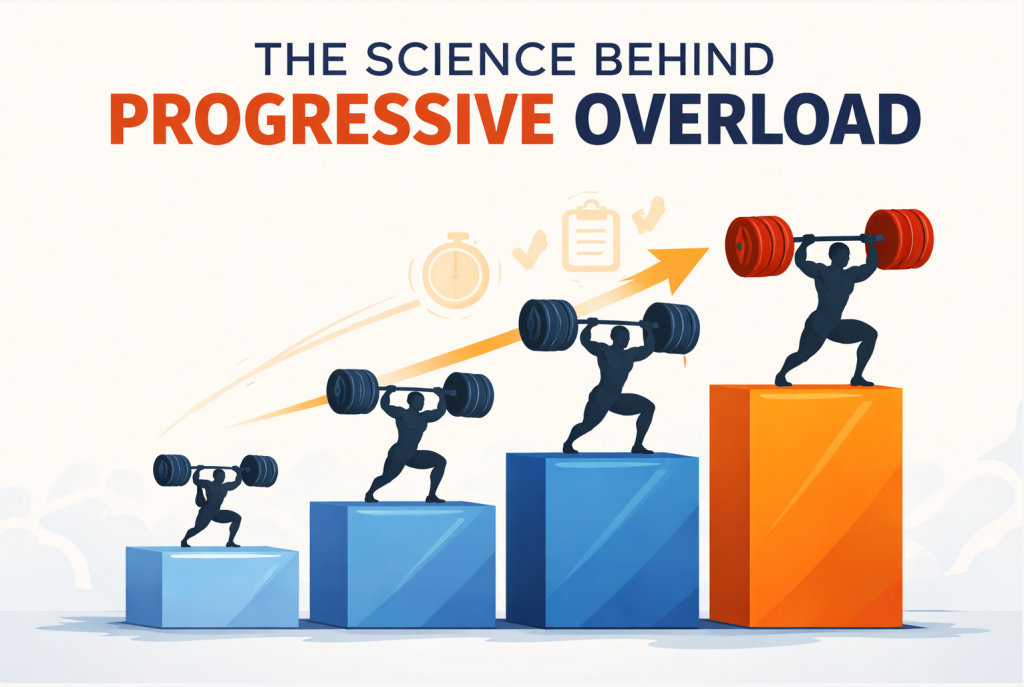
Progressive overload is the gradual increase of stress placed on the body during exercise. The concept was formalized by physician Thomas DeLorme in the 1940s during rehabilitative work with injured soldiers. He discovered that systematically increasing resistance accelerated recovery and strength gains far beyond static training protocols.
At its core, the principle is simple: your muscles adapt to the demands you place on them. Once adaptation occurs, those same demands no longer provide a sufficient stimulus. You must increase the challenge to continue progressing. “Increase” does not only mean more weight. There are multiple variables you can manipulate.
Variables You Can Progressively Overload
- Load (weight on the bar) — the most common and direct method
- Volume (sets × reps) — adding more total work over time
- Frequency — training a muscle group more often per week
- Density — doing the same work in less time (shorter rest periods)
- Range of motion — increasing depth or extension under load
- Tempo — slowing the eccentric (lowering) phase to increase time under tension
- Exercise complexity — progressing from a goblet squat to a barbell back squat
Each variable targets slightly different adaptation pathways. Effective programming rotates emphasis across these variables rather than pushing one to its absolute limit indefinitely.
Who This Information Is For
Progressive overload applies across virtually every training population. That said, this article is most useful for the following people:
- Beginners who feel lost following random workout routines with no clear progression plan
- Intermediate lifters who have hit a strength or size plateau after their initial “newbie gains”
- Self-coached athletes who want to understand the science behind their programming decisions
- Personal trainers looking to explain periodization concepts clearly to clients
- Anyone transitioning from cardio-focused fitness to structured resistance training
- Lifters who have trained for 6–24 months and are ready to move beyond beginner linear progression
- People returning from a training layoff who want to rebuild systematically and safely
- Fitness enthusiasts who prefer evidence-based methods over fitness influencer advice
Key Mechanisms: How Progressive Overload Works in the Body
1. Mechanical Tension — The Primary Driver of Muscle Growth
When a muscle contracts against a heavy load, the actin and myosin filaments inside each fiber experience mechanical tension. This tension activates mechanosensors in the cell membrane and triggers intracellular signaling — most importantly, the mTOR pathway (mechanistic target of rapamycin). mTOR activation directly stimulates muscle protein synthesis (MPS).
Research consistently identifies mechanical tension as the primary hypertrophy stimulus. Higher tension, sustained across an adequate range of motion, produces greater MPS responses. This is why compound lifts performed with progressively heavier loads remain the foundation of most effective programs.
2. Metabolic Stress in Weightlifting — The “Pump” Has a Purpose
Metabolic stress in weightlifting refers to the accumulation of metabolic byproducts — lactate, hydrogen ions, inorganic phosphate — during high-rep or short-rest training. This is largely what produces the sensation commonly known as “the pump.” For years, metabolic stress was considered a secondary or even trivial factor in muscle growth. More recent evidence suggests it plays a meaningful independent role.
Metabolic stress appears to promote hypertrophy through several mechanisms: cell swelling (which signals the muscle to grow to handle future stress), increased anabolic hormone release locally in the muscle, and enhanced fiber recruitment as fast-twitch motor units are forced to compensate for fatiguing slow-twitch fibers. Techniques like drop sets, supersets, and blood flow restriction (BFR) training deliberately exploit metabolic stress to drive growth even at lower absolute loads.
3. Muscle Damage — Controlled Breakdown Triggers Repair
Eccentric (lengthening) contractions under load cause micro-tears in muscle fibers. This damage initiates an inflammatory and repair response. Satellite cells — the stem cells of skeletal muscle — are activated to repair and reinforce the damaged tissue. Over time, the repaired fibers are structurally stronger and slightly larger.
Muscle damage is a real but easily over-rated mechanism. Soreness is not a reliable proxy for growth. Excessive damage — from dramatically increasing volume or introducing unfamiliar movements too quickly — impairs recovery and can reduce net muscle protein balance. The goal is controlled, progressive exposure, not maximum destruction.
4. The SAID Principle — Specific Adaptation to Imposed Demands
The body adapts specifically to the type of stress it receives. This is known as the SAID principle: Specific Adaptation to Imposed Demands. Heavy barbell training builds strength in the patterns used. High-volume training at moderate loads improves muscular endurance and hypertrophy in the muscles trained. Plyometric work improves rate of force development.
Progressive overload works best when the type of progression matches the adaptation you are chasing. Beginners can progress on almost any variable because everything is new. More advanced trainees must be more deliberate about which demand they are escalating and why.
5. Linear Periodization vs. Block Periodization — Which Model Progresses Faster?
Linear periodization increases load or volume in a straight, predictable line — typically adding weight to the bar each session (for beginners) or each week (for intermediates). It is simple to program, easy to track, and highly effective for lifters in their first one to three years of training. The limitation is that linear models eventually stall. You cannot add 5 lbs every week indefinitely.
Block periodization, developed by Soviet sports scientists and popularized by researcher Vladimir Issurin, divides training into concentrated blocks — each one targeting a specific quality (accumulation, intensification, realization). Rather than developing all qualities simultaneously, block periodization develops them sequentially, allowing deeper adaptation before shifting focus. Research supports block periodization as superior for intermediate and advanced athletes, particularly for peaking performance at a specific date. The trade-off is that it requires more planning and self-awareness about where you are in your development.
6. Deloads and Supercompensation — Rest Is Part of the Progression
Progressive overload does not mean constant escalation with no breaks. The supercompensation model explains that adaptation occurs during recovery — not during the training session itself. After a stressful stimulus, fitness temporarily dips (fatigue) before rising above the original baseline (supercompensation). Timing the next training stimulus to hit during the supercompensation window produces cumulative gains.
Planned deload weeks — typically every 4–8 weeks depending on training intensity and individual recovery capacity — allow accumulated fatigue to dissipate and adaptations to consolidate. Skipping deloads often leads to stalled progress, joint irritation, and eventual overtraining. The best lifters treat rest as a tool, not a sign of weakness.
Honest Pros and Cons of Progressive Overload Training
✅ Pros
- Backed by decades of peer-reviewed research — this is not a trend or a fad
- Works for virtually every training goal: strength, hypertrophy, endurance, and athletic performance
- Provides clear direction — you always know what to aim for in the next session
- Scalable for all experience levels, from complete beginners to competitive powerlifters
- Reduces the risk of stagnation by building adaptation into the structure of the program
- Can be applied across many training modalities — barbells, dumbbells, machines, cables, and bodyweight
❌ Cons
- Requires consistent tracking — progress is hard to manage if you do not log your workouts
- Linear progression stalls within 1–2 years for most lifters, requiring more sophisticated planning
- Pushing too aggressively on load increases injury risk, especially in untrained movement patterns
- Metabolic stress techniques (drop sets, supersets) can impair recovery if overused without structure
- Block periodization models have a steeper learning curve and can be poorly executed by beginners
- Life stress, sleep deprivation, and poor nutrition will undermine progression regardless of the program design
How Progressive Overload Compares to Other Training Approaches
Progressive Overload vs. Undulating Periodization (DUP)
Daily Undulating Periodization (DUP) alternates rep ranges and training intensities across sessions within the same week — for example, heavy (3–5 reps) on Monday, moderate (8–10 reps) on Wednesday, and light/metabolic (15–20 reps) on Friday. This model keeps the stimulus varied and has solid evidence for both strength and hypertrophy gains. It also reduces the psychological monotony that can come with straight linear progression. However, DUP requires more session-to-session planning and can be difficult to manage for beginners who are still building foundational movement skill.
Bottom line: DUP is a valid and well-researched variation of progressive overload — not a replacement for it. The principles are the same; only the organization differs.
Progressive Overload vs. Instinctive Training
Instinctive training — choosing exercises, weights, and volume based on how you feel each day — is popular in bodybuilding culture and often promoted by experienced athletes. For advanced lifters with 10+ years of training, there may be value in autoregulation. For the majority of gym-goers, instinctive training is a euphemism for avoiding discomfort. Without a target to hit, most people default to comfortable weights and comfortable rep counts, which generates comfortable (i.e., minimal) results. Controlled progressive programs consistently outperform unstructured approaches in research comparing the two.
Bottom line: Instinctive training is not a strategy — it is the absence of one. Progressive overload wins for anyone seeking measurable, long-term results.
Who Should Follow a Progressive Overload Program — And Who Should Skip It
✅ Buy / Start a Structured Program If You Are:
- A beginner with no current periodization structure in your training
- An intermediate lifter whose strength gains have stalled for 4+ weeks
- Someone training for a specific goal — a powerlifting meet, a physique competition, or a strength benchmark
- A person returning from injury or an extended break who needs a structured ramp-up plan
- Anyone whose current program does not include a defined progression scheme or deload protocol
- A trainer who wants a research-backed framework to explain to clients
- Someone motivated by data and tracking who wants to see clear evidence of progress over weeks and months
- A lifter who is ready to commit to consistent logging and honest self-assessment
❌ Skip or Wait If You Are:
- Still learning foundational movement patterns — progressive overload on poor form accelerates injury, not progress
- Training primarily for general health and have no interest in tracking numbers — intuitive moderate-intensity movement is fine for that goal
- Unable to train consistently at least 3 days per week — structured progression requires sufficient training frequency to function
- Dealing with an unresolved injury that requires rest or physical therapy — load progression is not appropriate until cleared
- In a period of very high life stress or severe sleep deprivation — recovery capacity will be too impaired for progression to accumulate
- Looking for a short-term challenge rather than a long-term development plan — progressive overload pays off over months and years, not days
- A complete beginner who has not yet spent 4–8 weeks on basic movement competency first
Final Verdict: The Most Reliable Principle in All of Strength Training
After decades of research and thousands of studies on resistance training, progressive overload remains the single most consistent predictor of long-term strength and muscle gains. Trends come and go. Training methodologies get rebranded. But the fundamental biological requirement — that muscles must face progressively greater demands to continue adapting — has never been overturned. It cannot be, because it is rooted in basic physiology.
The three pillars covered in this article — mechanical tension, metabolic stress in weightlifting, and smart periodization — give you a complete picture of how to build a program that actually works. Understanding linear periodization vs. block periodization lets you match your programming to your experience level rather than following a one-size-fits-all template that may not suit where you actually are in your development.
The hard truth is that most lifters already know they need to train harder and smarter over time. The gap is almost never knowledge — it is structure. A well-designed progressive overload program removes the guesswork. It tells you exactly what to do each session, when to push, when to pull back, and how to keep the process moving forward even when motivation fluctuates.