

You’re Doing Everything Right — So Why Aren’t You Seeing Results?
You track your calories. You hit the gym consistently. You eat enough protein. But your body composition isn’t changing the way it should. The missing variable might not be your diet or your training. It might be what happens — or doesn’t happen — when you close your eyes at night.
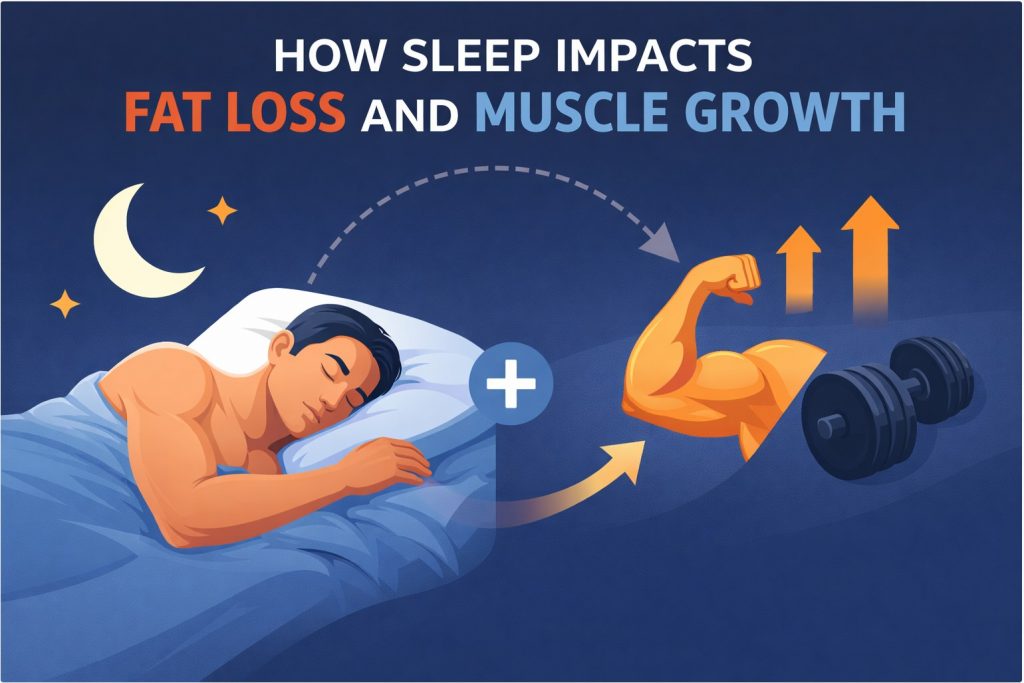
Understanding how sleep affects muscle growth and fat loss changes the way you think about recovery. Sleep isn’t passive downtime. It’s when your body does the actual work of repairing muscle, regulating hormones, and burning stored fat efficiently. Without enough of it, those processes break down at the cellular level.
This article breaks down the science clearly. No jargon overload. Just what you need to know to make sleep a deliberate part of your fitness strategy.
What the Research Actually Says About Sleep and Body Composition
Sleep and body composition are tightly linked. Research consistently shows that people who sleep fewer than 7 hours per night lose more muscle and less fat during a caloric deficit compared to those sleeping 8–9 hours. That’s not a minor difference. In one widely cited study, sleep-deprived participants lost 55% less fat and 60% more lean mass than well-rested subjects on the same diet.
There are four key mechanisms at work: growth hormone secretion, cortisol regulation, insulin sensitivity, and REM sleep duration. Each one has a measurable impact on whether your body builds or breaks down tissue overnight.
Quick Sleep and Fitness Overview
- Optimal sleep for muscle recovery: 7–9 hours per night for most adults
- Peak growth hormone release: Occurs during slow-wave (deep) sleep, Stage 3 NREM
- REM sleep and recovery: REM cycles become longer in the second half of the night
- Cortisol spike from poor sleep: A single bad night can raise cortisol by 37–45%
- Sleep and insulin sensitivity: Poor sleep reduces glucose uptake and promotes fat storage
- Appetite hormones affected: Ghrelin rises, leptin falls — both drive overeating
- Testosterone impact: Even one week of short sleep reduces testosterone by up to 15%
Who Needs to Pay Attention to This
Who This Information Is For
This isn’t just for elite athletes or bodybuilders. Anyone trying to change their body composition needs to understand the role sleep plays in that process.
- People in a fat-loss phase who have stalled despite a caloric deficit
- Gym-goers who feel chronically under-recovered between sessions
- Busy professionals sleeping 5–6 hours and wondering why muscle gains are slow
- Women experiencing hormonal shifts that disrupt sleep and body composition simultaneously
- Men over 35 with declining testosterone noticing increased belly fat
- Anyone doing high-intensity training more than 3 days per week
- People who eat well and exercise but still carry excess visceral fat
- Anyone who regularly wakes up tired and relies on caffeine to function
Key Features of Sleep That Drive Muscle Growth and Fat Loss
1. Growth Hormone Release During Deep Sleep
The majority of daily human growth hormone (HGH) is released during Stage 3 NREM sleep — the deepest phase. HGH drives muscle protein synthesis and signals fat cells to release stored energy. Cutting sleep short means cutting this release short.
Adults who regularly sleep under 6 hours show significantly blunted HGH pulses. This directly reduces the anabolic signal your muscles receive overnight — the very signal that makes your gym work pay off.
2. Cortisol and Belly Fat: How Stress Hormones From Poor Sleep Inhibit Fat Loss
Cortisol and belly fat have a well-documented relationship. Cortisol is a catabolic hormone. In controlled amounts, it’s useful. Chronically elevated, it actively promotes fat storage — especially visceral fat around the abdomen — while simultaneously breaking down muscle tissue for fuel.
Poor sleep is one of the most reliable triggers for chronic cortisol elevation. When you’re sleep-deprived, your body interprets that as a physiological stressor. Cortisol rises, fat oxidation slows, and your body preferentially stores energy rather than burning it. This is why stress hormones from poor sleep inhibit fat loss even when calories are controlled.
3. How Many Hours of REM Sleep for Muscle Recovery?
REM sleep doesn’t directly drive muscle protein synthesis the way deep sleep does. But asking how many hours of REM sleep for muscle recovery is still the right question — because REM has critical indirect roles. It regulates the nervous system, consolidates motor learning, and manages the hormonal balance between testosterone and cortisol.
Most adults need 90–120 minutes of REM per night, which typically means 4–5 full sleep cycles of roughly 90 minutes each. That’s 7.5–9 hours of total sleep. Cutting sleep short disproportionately cuts REM, since REM cycles are longer in the second half of the night.
4. Insulin Sensitivity and Fat Storage
Sleep deprivation reduces insulin sensitivity in muscle and fat tissue. When cells respond poorly to insulin, glucose stays in the bloodstream longer. The pancreas produces more insulin to compensate. Elevated insulin is a strong signal for fat storage and a strong inhibitor of fat burning.
Just four nights of sleeping 4.5 hours has been shown to reduce insulin sensitivity by roughly 16%. Over weeks and months, this significantly impairs fat loss even at a caloric deficit.
5. Appetite Hormones: Ghrelin and Leptin
Ghrelin (the hunger hormone) rises with sleep deprivation. Leptin (the satiety hormone) falls. The net result is increased appetite, stronger cravings for calorie-dense foods, and reduced ability to feel full after eating. This isn’t a willpower problem. It’s a hormonal one.
Studies show that sleep-deprived adults consume an average of 300–400 extra calories per day compared to well-rested peers. That alone can erase a fat-loss deficit without any change in exercise or intentional eating habits.
6. Testosterone and Anabolic Signaling
Testosterone is a primary driver of muscle protein synthesis in both men and women. A significant portion of daily testosterone is produced and released during sleep, particularly during REM and late-stage NREM. One study from the University of Chicago found that sleeping 5 hours per night for one week reduced testosterone levels by 10–15% in healthy young men.
Lower testosterone means weaker anabolic signaling. Combined with elevated cortisol, the body shifts toward catabolism — breaking down muscle rather than building it. This is the hormonal environment chronic sleep deprivation creates.
7. Muscle Protein Synthesis Overnight
Muscle is not built in the gym. It’s built during recovery — and sleep is peak recovery time. Muscle protein synthesis (MPS) continues during sleep when amino acid availability is sufficient. This is one reason pre-sleep protein (casein or whole food sources) is a valid strategy for muscle building.
Without adequate sleep duration, MPS rates drop. Cells don’t complete the repair cycle initiated by training. The result is slower strength gains, longer soreness periods, and reduced hypertrophy over time.
Honest Pros and Cons of Prioritizing Sleep for Body Composition
✅ Benefits of Optimizing Sleep for Fat Loss and Muscle Growth
- Increases natural HGH secretion without supplementation
- Lowers chronic cortisol — directly reducing visceral fat accumulation
- Improves insulin sensitivity, making the same diet more effective for fat loss
- Supports higher testosterone levels for better muscle-building outcomes
- Reduces daily calorie intake by normalizing hunger hormones
- Improves workout performance, allowing more training volume over time
- Speeds up recovery, reducing injury risk from overtraining
❌ Challenges and Limitations to Know
- Sleep quality is hard to control — stress, kids, shift work all interfere
- Improving sleep takes consistent lifestyle changes, not quick fixes
- More sleep doesn’t linearly mean more muscle — other variables still matter
- Oversleeping (10+ hours regularly) may signal underlying health issues
- Sleep tracking devices vary in accuracy for measuring REM and deep sleep
- Caffeine, alcohol, and blue light habits can undermine even good sleep intentions
- Individual sleep needs vary — 7 hours may not be enough for high training volumes
How Sleep Compares to Other Recovery Strategies
Sleep vs. Active Recovery (Foam Rolling, Walking, Stretching)
Active recovery has real value — it increases blood flow, reduces muscle soreness, and maintains movement patterns. But it doesn’t trigger the hormonal environment that sleep creates. You can foam roll for an hour and still have elevated cortisol and blunted HGH. Active recovery works best as a complement to sleep, not a substitute for it.
Bottom line: Active recovery addresses symptoms. Sleep addresses the root hormonal environment that determines whether your body builds or breaks down.
Sleep vs. Supplements (Creatine, Protein, Adaptogens)
Supplements like creatine, whey protein, and ashwagandha each have meaningful evidence behind them. But they operate on top of your recovery baseline. Creatine improves strength output. Protein supports MPS. Adaptogens can blunt cortisol modestly. None of them replicate what 8 hours of quality sleep does to your hormonal environment.
Bottom line: Supplements optimize a good foundation. Sleep creates the foundation. Prioritize in that order.
Who Should Prioritize Sleep Optimization / Who Can Be Less Strict
Make sleep a non-negotiable if you:
- Are currently in a fat-loss phase and have stalled despite a caloric deficit
- Train 4 or more days per week with moderate to high intensity
- Are over 35 and dealing with slower recovery times
- Notice increased belly fat despite consistent exercise
- Feel chronically tired, irritable, or unmotivated to train
- Are trying to gain muscle and progress in the gym has stalled
- Have high daily stress from work, relationships, or life circumstances
- Struggle with food cravings, especially in the evening
You have more flexibility if you:
- Train recreationally 1–2 times per week at low intensity
- Are currently in a maintenance phase with no active body composition goal
- Naturally sleep 8+ hours without effort and wake refreshed
- Are young (18–25) with robust natural hormone production
- Have very low stress levels and strong baseline recovery capacity
- Already eat at a consistent surplus and are gaining strength steadily
Final Verdict: Sleep Is the Most Underrated Fitness Variable
The data is clear. Sleep isn’t a passive recovery tool. It’s an active physiological process that regulates every hormone involved in muscle growth and fat metabolism. Understanding how sleep affects muscle growth reframes recovery from optional to essential.
If you’re sleeping under 7 hours regularly, you’re training with a hormonal hand tied behind your back. Cortisol is elevated. Testosterone is suppressed. HGH release is blunted. Insulin sensitivity is reduced. Hunger hormones are dysregulated. That’s not a scenario where fat loss and muscle growth thrive — no matter how dialed-in your training and nutrition are.
The good news: sleep is a modifiable variable. Basic changes — consistent bed and wake times, a cool and dark room, limiting alcohol and screens before bed — produce measurable improvements in sleep quality within 1–2 weeks. The hormonal payoff follows quickly.
Treat sleep like a training session. Schedule it. Protect it. Optimize it. It’s not the least important part of your fitness plan. It might be the most important one.
⭐⭐⭐⭐⭐ Priority Rating: 5/5 — Non-negotiable for serious body composition results