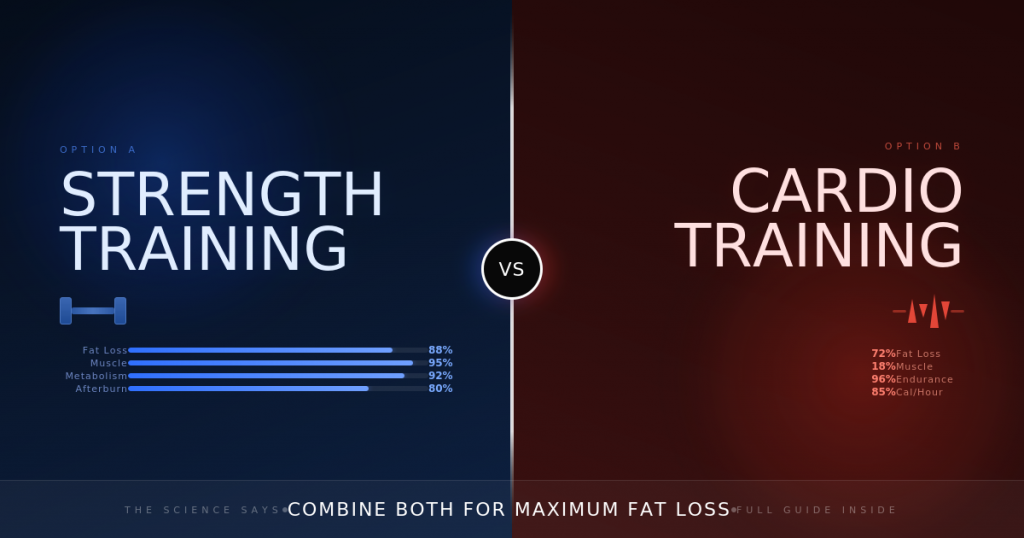

The strength training vs. cardio debate is one of the most enduring controversies in the fitness world. Walk into any gym and you’ll find two camps: the cardio crowd grinding away on treadmills and ellipticals, and the lifters pumping iron in the weights section. Both sides will insist their approach is superior for burning fat.
The truth, backed by a growing body of scientific research, is more nuanced — and more empowering — than either camp admits. This comprehensive guide breaks down exactly what the science says about both modalities, their unique fat-burning mechanisms, and how to strategically combine them for the best possible results.
Defining the Terms
What Is Cardio?
Cardiovascular exercise (cardio) refers to any repetitive, rhythmic activity that elevates your heart rate and primarily uses your aerobic energy system. Common examples include running, cycling, swimming, rowing, brisk walking, dancing, and using the elliptical. Cardio is typically categorized as:
- LISS (Low-Intensity Steady State): Extended, moderate-pace exercise — like a 45-minute jog or bike ride. Burns primarily fat for fuel during the activity.
- HIIT (High-Intensity Interval Training): Short bursts of maximum effort alternated with rest periods. Dramatically higher calorie burn per minute than LISS.
What Is Strength Training?
Strength training (also called resistance training or weight training) uses resistance — bodyweight, free weights, machines, or bands — to contract muscles against an opposing force. The goal is to build or maintain muscle mass and improve functional strength. Examples include barbell squats, bench press, deadlifts, pull-ups, and dumbbell exercises.
How Each Burns Fat: The Core Mechanisms
How Cardio Burns Fat
Cardio burns calories in a relatively straightforward way: sustained physical activity increases energy expenditure. During moderate-intensity cardio, a significant portion of that energy comes directly from fat stores (fatty acid oxidation).
A 30-minute run at a moderate pace burns approximately 250–400 calories, depending on body weight and intensity. The “fat burning zone” (roughly 60–70% of maximum heart rate) maximizes the proportion of calories coming from fat during exercise — though total calorie expenditure is lower than higher-intensity efforts.
The primary limitation of cardio for fat loss is that its metabolic effects largely end when the activity stops. Once you step off the treadmill, your calorie burn returns to baseline relatively quickly.
How Strength Training Burns Fat
Strength training’s fat-burning mechanism is less immediate but more enduring. Here’s why it’s so powerful for long-term fat loss:
- Calorie burn during exercise: A 45-minute weight training session burns 200–400 calories, comparable to moderate cardio.
- EPOC (Excess Post-Exercise Oxygen Consumption): Also called the “afterburn effect,” EPOC refers to elevated calorie burning that continues for up to 24–48 hours after strength training while your body repairs muscle tissue. Research suggests HIIT and heavy strength training produce the highest EPOC values.
- Muscle mass increases metabolic rate: Each pound of muscle tissue burns approximately 6–10 calories per day at rest, compared to 2–3 calories per pound of fat. This may sound small but becomes significant at scale — gaining 10 pounds of muscle raises your resting metabolic rate by 60–100 calories per day, which adds up to 3–5 pounds of additional fat loss per year without any other changes.
- Long-term metabolic advantages: As muscle mass increases, the body becomes a more efficient fat-burning machine around the clock — not just during exercise.

What the Research Actually Shows
Cardio for Fat Loss
A comprehensive meta-analysis published in the Journal of Obesity found that aerobic exercise programs produced meaningful fat loss, with longer duration and higher frequency producing greater results. However, the same research noted that cardio-only programs often led to compensatory eating — participants unconsciously consumed more calories after cardio sessions, partially offsetting the caloric deficit created by exercise.
Additionally, extended cardio without strength training can lead to muscle loss, particularly in a caloric deficit. Losing muscle lowers your resting metabolic rate, making ongoing fat loss progressively harder — a phenomenon sometimes called the “cardio trap.”
Strength Training for Fat Loss
A 2012 study in the journal Obesity compared aerobic training, resistance training, and combined training over 8 months. While aerobic training produced greater total weight loss, resistance training produced superior improvements in body composition — participants who lifted weights lost more fat relative to total weight lost and gained muscle simultaneously.
Multiple studies have demonstrated that strength training produces equivalent or superior fat loss compared to cardio when total caloric expenditure is matched — with the critical advantage of preserving or building muscle mass.
The Combined Approach: The Clear Winner
Research consistently shows that combining strength training and cardio produces better fat loss outcomes than either modality alone. A pivotal study published in the American Journal of Cardiology found that a combined aerobic and resistance training program was significantly more effective for reducing total body fat than either approach individually.
The synergy works like this: cardio creates an immediate caloric deficit and improves cardiovascular health; strength training builds the metabolic machinery that makes fat burning easier long-term. Together, they cover all bases.
The Body Composition Argument: Beyond Just “Fat Loss”
One of the most important distinctions in the cardio vs. strength training debate is the difference between “weight loss” and “fat loss.”
The scale measures total body weight — fat, muscle, water, bone, and organ mass combined. Cardio alone can produce significant scale weight loss, but a meaningful portion of that loss may be muscle mass, which has serious long-term metabolic consequences.
Strength training targets body composition — the ratio of fat mass to lean mass. By building or preserving muscle while losing fat, you can:
- Look leaner and more defined at the same body weight
- Maintain a higher metabolic rate, making it easier to keep fat off
- Develop functional strength that improves quality of life
- Reduce risk of metabolic diseases, osteoporosis, and injury
This is why many fitness experts now recommend judging progress by body composition measurements (body fat percentage, muscle measurements, progress photos) rather than scale weight alone.
Which Is Right for You? Practical Guidance by Goal
If Your Primary Goal Is Maximum Calorie Burn in the Shortest Time
HIIT cardio wins. A 20-minute HIIT session can burn more calories than a 45-minute moderate run, both during the session and through its elevated EPOC effect. HIIT is the most time-efficient fat-burning tool available. However, it’s high-impact and requires more recovery time — limit HIIT to 2–3 sessions per week maximum.
If Your Primary Goal Is Long-Term Fat Loss and Body Composition
Strength training wins. Building muscle increases your resting metabolic rate, protects against the muscle loss that accompanies dieting, and reshapes your body in ways cardio simply cannot. For sustainable, lasting fat loss and a lean physique, progressive resistance training is non-negotiable.
If Your Goal Is Overall Health, Energy, and Longevity
The combination wins decisively. Research on longevity consistently shows that individuals who perform both strength training and aerobic exercise have the lowest all-cause mortality rates, best cardiovascular health, and greatest functional capacity as they age.
If You’re a Complete Beginner
Start with 3 days of full-body strength training per week and 2–3 days of moderate cardio (brisk walking is perfect). This combination maximizes fat burning, builds muscle, improves cardiovascular health, and establishes multiple sustainable habits simultaneously.
Designing the Optimal Fat Loss Program
Here is a practical weekly template that combines strength training and cardio for maximum fat loss while preserving muscle:
Sample 5-Day Fat Loss Program
- Monday: Strength training — Full body (45 minutes)
- Tuesday: Cardio — LISS walk, jog, or bike (30–45 minutes)
- Wednesday: Strength training — Full body (45 minutes)
- Thursday: Cardio — HIIT (20–25 minutes) or complete rest
- Friday: Strength training — Full body (45 minutes)
- Saturday: Active recovery — Light walking, yoga, swimming
- Sunday: Full rest
This template trains each muscle group 3 times per week, includes 2–3 cardio sessions of varying intensity, and incorporates full rest and active recovery to allow optimal adaptation and fat burning.
Cardio Timing: Before or After Weights?
When combining cardio and strength training in the same session, research generally recommends performing strength training first. Doing cardio first depletes glycogen stores and pre-fatigues the muscles, which impairs lifting performance and reduces the strength training stimulus. Lifting first allows maximum strength output, followed by cardio that uses the fat-burning hormonal state created by the weights session.

The Role of Nutrition in the Equation
It’s impossible to discuss fat loss without addressing nutrition — because no amount of cardio or strength training can compensate for a poor diet. The most effective fat loss strategy combines smart training with nutrition fundamentals:
- Caloric deficit: Create a modest deficit of 300–500 calories per day through a combination of diet reduction and exercise. Larger deficits impair muscle retention and performance.
- High protein intake: Aim for 0.8–1 gram per pound of body weight. Protein is thermogenic (burns calories during digestion), preserves muscle during a deficit, and promotes satiety.
- Carbohydrates for performance: Don’t eliminate carbs — use them strategically. Eat higher carb on training days to fuel workouts and replenish glycogen. Slightly reduce carbs on rest days.
- Prioritize whole foods: A diet based on vegetables, fruits, lean proteins, whole grains, and healthy fats provides the micronutrients needed for optimal performance and recovery.
Common Myths, Busted
Myth: Cardio is the best way to lose fat.
Reality: Cardio burns calories but doesn’t build muscle or meaningfully raise resting metabolic rate. For lasting fat loss, strength training’s metabolic benefits are essential.
Myth: Lifting weights will make you bulky.
Reality: Building significant muscle mass requires years of progressive training and a caloric surplus. Most people — especially women — will become leaner and more toned, not bulky, from strength training.
Myth: You should do cardio on an empty stomach (fasted cardio) to burn more fat.
Reality: While fasted cardio does slightly increase fat oxidation during exercise, total 24-hour fat loss is equivalent to fed-state cardio. The differences are marginal and don’t justify the potential muscle breakdown risks of prolonged fasted training.
Myth: More cardio always equals more fat loss.
Reality: Excessive cardio elevates cortisol, can cause muscle breakdown, increases appetite, and often leads to compensatory eating. There is a point of diminishing returns — and even negative returns — with very high cardio volume.
The Verdict: What Should You Do?
If you’re forced to choose one or the other, the evidence favors strength training for body composition and long-term fat loss. Building muscle creates a metabolic advantage that cardio simply cannot replicate.
However, the smartest approach by far is to combine both: use strength training as your primary training modality (3–4 days per week) and add strategic cardio (2–3 days per week) for additional caloric expenditure, cardiovascular health, and metabolic benefits.
This combination, paired with a high-protein, moderate-calorie diet and sufficient sleep, is the most scientifically validated approach to sustainable fat loss available. It’s not complicated. It just requires consistency.
Final Thoughts
The cardio vs. strength training debate is a false choice. Rather than picking sides, the evidence points to a clear conclusion: they serve different purposes and deliver different benefits — both of which are essential to optimizing fat loss and overall health.
Stop choosing between the two. Start building a training life that includes both. Your body will burn fat more efficiently, look better, feel better, and stay healthier for decades to come.
The gym has both a squat rack and a treadmill for a reason. Use them both.